
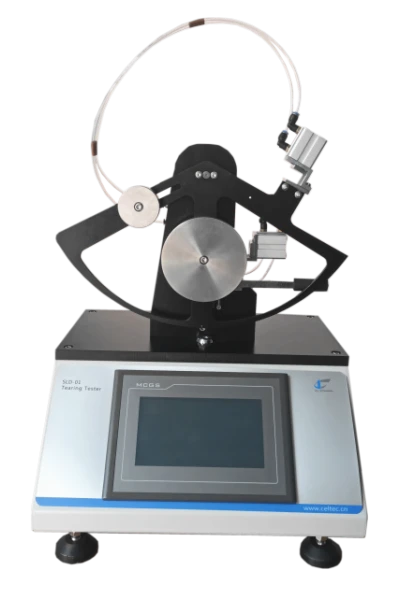
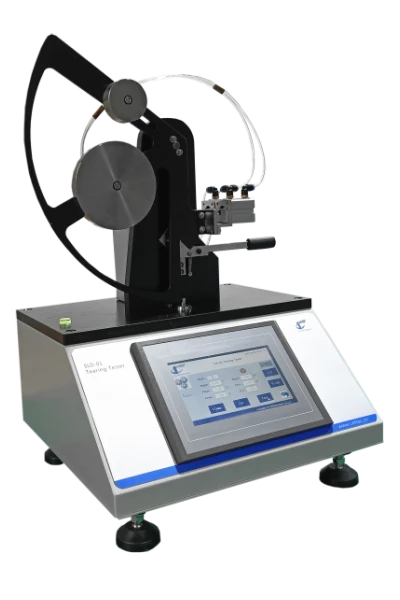
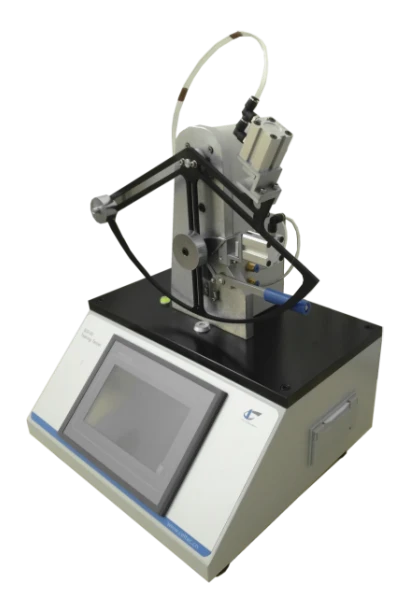
The elmendorf tearing tester is an essential laboratory instrument for measuring the tear resistance of paper, plastic films, textiles, nonwoven materials, and flexible packaging. Using the proven Elmendorf method, the instrument determines the force required to propagate an existing tear under controlled conditions, providing highly repeatable and standardized results for quality control, product development, and material comparison.
Whether you manufacture packaging films, paper products, medical packaging, or industrial materials, an elmendorf tearing tester helps evaluate material durability, optimize product performance, and ensure compliance with international standards such as ASTM D1922, ASTM D689, ISO 6383-2, and ISO 1974.
What Is an Elmendorf Tearing Tester?
An elmendorf tearing tester measures the force required to continue a pre-cut tear in a material using a calibrated pendulum. Rather than measuring the force needed to initiate a tear, the instrument evaluates tear propagation resistance, making it one of the most widely accepted methods for assessing material toughness.
The instrument is commonly used for:
- Plastic films
- Flexible packaging materials
- Paper and paperboard
- Textile fabrics
- Nonwoven materials
- Laminated structures
- Composite materials
The generated tear strength data helps engineers compare materials, verify production consistency, and evaluate whether a material meets product specifications.
Cell Instruments SLD-01 Elmendorf Tearing Tester
The SLD-01 Elmendorf Tearing Tester from Cell Instruments is engineered to deliver accurate, repeatable, and standards-compliant tear testing for modern quality laboratories.
Key Technical Features
| Feature | Benefit |
|---|---|
| PLC control with HMI touchscreen | Stable operation with intuitive setup |
| Pneumatic specimen clamping | Uniform clamping pressure for excellent repeatability |
| Automatic pendulum release | Eliminates operator variation |
| Integrated calibration weights | Convenient verification of multiple force ranges |
| Automatic statistical analysis | Immediate calculation of average, maximum, minimum, and test variation |
| Optional professional software | Advanced reporting and data management |
| Optional printer & RS-232 interface | Easy report generation and data export |
| Paper-specific units | Optional mN and tear index outputs for paper testing |
Technical Specifications
| Parameter | Specification |
|---|---|
| Pendulum Capacity | 200, 400, 800, 1600, 3200, 6400 gf |
| Tearing Arm | 104 ± 1 mm |
| Initial Pendulum Angle | 27.5° ± 0.5° |
| Pneumatic Supply | 0.6 MPa |
| Power Supply | AC 110–220 V, 50/60 Hz |
Multiple pendulum capacities allow the instrument to test a wide range of materials from lightweight plastic films to heavier paper products.
Why Is Tear Resistance Important?
Tear resistance directly affects product reliability during manufacturing, transportation, storage, and end use. Materials with insufficient tear resistance may fail prematurely, while overly tear-resistant materials can negatively affect package opening performance.
A reliable tear strength test method helps manufacturers:
- Verify raw material quality
- Compare material formulations
- Evaluate film orientation effects
- Optimize multilayer packaging structures
- Improve product durability
- Reduce material waste
- Meet customer specifications
- Maintain regulatory compliance
For flexible packaging manufacturers, understanding the tear strength of plastic film is particularly important because tear performance influences package handling, consumer convenience, and overall package integrity.
How Does the Elmendorf Method Work?
The Elmendorf method measures tear resistance using the potential energy of a calibrated pendulum.
The testing principle is straightforward:
- A specimen is prepared according to the applicable standard.
- A precisely controlled pre-cut notch is introduced.
- The specimen is clamped securely.
- The pendulum is released automatically.
- As the pendulum swings, it propagates the tear through the remaining specimen.
- The instrument calculates the energy absorbed during tearing and converts it into tear force.
Because the pendulum movement is highly repeatable, the method minimizes operator influence and produces reliable comparative results.
Tear Strength Test Method for Different Materials
Different materials require different international testing standards.
| Material | Typical Standard | Primary Measurement |
|---|---|---|
| Plastic Film | ASTM D1922 / ISO 6383-2 | Tear propagation resistance |
| Paper | ASTM D689 / ISO 1974 | Paper tear resistance |
| Paperboard | ISO 1974 | Tear force |
| Nonwoven Fabrics | Product-specific standards | Tear strength |
| Flexible Packaging | ASTM D1922 | Tear resistance comparison |
Selecting the appropriate tear strength test method ensures that laboratory data can be compared across suppliers, customers, and production facilities.
Standards Supported
An advanced elmendorf tearing tester supports multiple international testing standards, allowing one instrument to serve various industries.
ASTM D1922 Standard Test Method for Propagation Tear Resistance of Plastic Film and Thin Sheeting by Pendulum Method
ASTM D1922 specifies the determination of the tearing resistance of plastic film and thin sheeting using the pendulum method. It is widely adopted in the plastics and flexible packaging industries.
ASTM D689 Standard Test Method for Internal Tearing Resistance of Paper
ASTM D689 covers the determination of internal tearing resistance of paper using the Elmendorf pendulum apparatus. It is commonly used by paper manufacturers and testing laboratories.
ISO 6383-2 Plastics — Film and sheeting — Determination of tear resistance — Part 2: Elmendorf method
ISO 6383-2 specifies the determination of tear propagation resistance of plastic films using the Elmendorf method and is recognized globally for film quality evaluation.
ISO 1974 Paper — Determination of tearing resistance — Elmendorf method
ISO 1974 defines the measurement of tearing resistance for paper using the Elmendorf principle and is frequently required by pulp and paper manufacturers.
Why Choose Cell Instruments?
Cell Instruments specializes in material testing technologies for packaging, plastics, paper, medical devices, pharmaceuticals, adhesives, and industrial materials.
Beyond standard laboratory instruments, we provide:
- Customized testing systems
- Multi-station automation solutions
- Special fixtures
- Application-specific testing methods
- Technical consultation
- Global customer support
Accurate tear resistance data is essential for developing durable, high-quality materials and ensuring consistent manufacturing performance. Cell Instruments offers the SLD-01 Elmendorf Tearing Tester together with customized fixtures, automated testing systems, and application-specific testing solutions to meet diverse laboratory requirements. Whether you need to evaluate plastic films, paper products, or advanced packaging materials, our technical experts can help you select the most suitable testing solution. Contact Cell Instruments today to discuss your testing requirements and request a customized quotation.


