
Plastic films are widely used in flexible packaging, medical packaging, agricultural films, industrial liners, and consumer products. While tensile strength and puncture resistance are important mechanical properties, tear resistance often determines whether a film can withstand handling, transportation, and end-use conditions without catastrophic failure.
ISO 6383-2 provides a standardized procedure for measuring the tear resistance of flexible plastic film and sheeting using the Elmendorf method. By quantifying the force required to propagate an existing tear, the standard enables manufacturers to compare materials, optimize formulations, maintain production consistency, and verify product quality.
This article explains the purpose of ISO 6383-2, the working principle of the elmendorf tear test of plastic film, testing procedures, result interpretation, applicable materials, equipment selection, and practical applications from the perspective of laboratory testing and industrial quality control.
What Is ISO 6383-2?
ISO 6383-2: Plastics — Film and Sheeting — Determination of Tear Resistance — Part 2: Elmendorf Method specifies a standardized test for determining the force required to propagate a tear through a thin flexible plastic film or sheet.
Unlike tensile testing, which measures resistance to stretching until rupture, ISO 6383-2 focuses on tear propagation. The test evaluates how much force is needed to continue tearing a specimen after a controlled initial slit has been introduced.
Because packaging failures frequently begin with small cuts or defects, tear resistance measured according to ISO 6383-2 is often a better indicator of real-world durability than tensile strength alone.
Why Tear Resistance Matters
For many flexible materials, small defects can quickly develop into large failures during converting, filling, shipping, or consumer use.
Typical quality objectives include:
- Prevent package failure during transportation
- Improve consumer opening performance
- Optimize multilayer film structures
- Compare raw material formulations
- Monitor extrusion process stability
- Verify product consistency between production batches
The elmendorf tear test of plastic film provides quantitative data that supports these quality control objectives.
The Elmendorf Method Explained
The elmendorf method measures the energy required to propagate a tear after an initial cut has already been made.
Elmendorf Tear Test Principle
A precisely prepared specimen containing a standard slit is clamped vertically inside the tester.
A pendulum is raised to a specified position, storing potential energy.
When released:
- The pendulum swings freely.
- The moving clamp tears the specimen.
- Part of the pendulum energy is consumed propagating the tear.
- The remaining energy is measured.
- Tear resistance is calculated from the energy loss.
The measured value represents the force, expressed in newtons (N), required to continue the tear.
Because the pendulum supplies highly repeatable energy, the elmendorf method provides excellent reproducibility when properly performed.
Test Procedure According to ISO 6383-2
Although laboratories may have different workflows, the essential procedure follows several standardized steps.
1. Instrument Verification
Before testing:
- Verify the tester is level.
- Check pendulum zero position.
- Confirm calibration.
- Select the appropriate pendulum capacity.
Proper setup ensures reliable results throughout the testing process.
2. Determine Appropriate Pendulum Capacity
The pendulum should be selected so that measured values fall approximately between 20% and 80% of the instrument’s full-scale capacity.
If necessary:
- Install additional weights.
- Test multiple specimens simultaneously.
This improves measurement accuracy.
3. Mount the Specimen
The specimen is carefully positioned between the fixed and movable clamps.
Important considerations include:
- Slit centered between clamps
- Firm specimen clamping
- No specimen slippage
- Correct alignment
Proper positioning minimizes testing variability.
4. Release the Pendulum
The pendulum is automatically released.
As it swings:
- The tear propagates through the specimen.
- Energy loss is measured.
- Tear resistance is calculated.
5. Evaluate Tear Path
Results should be rejected if:
- The tear deviates excessively from the specified path.
- The specimen tears outside acceptable limits.
Additional specimens should then be tested to obtain valid data.
6. Calculate Results
Individual tear resistance values are recorded.
The laboratory then calculates:
- Mean tear resistance
- Machine Direction (MD)
- Transverse Direction (TD)
Reporting both directions is particularly important because many plastic films exhibit anisotropic mechanical properties.
Interpreting Test Results
Higher tear resistance generally indicates better resistance to tear propagation.
However, results should always be interpreted together with other mechanical properties such as:
- Tensile strength
- Elongation
- Dart impact resistance
- Puncture resistance
- Seal strength
For example:
| Property | Indicates |
|---|---|
| High tensile strength + low tear resistance | Film resists stretching but tears easily once damaged |
| High tear resistance + moderate tensile strength | Film better withstands cuts during handling |
| Balanced properties | Ideal for demanding packaging applications |
The elmendorf tear test of plastic film therefore complements other mechanical tests rather than replacing them.
Choosing an Elmendorf Tearing Strength Tester
A reliable elmendorf tearing strength tester should provide accurate pendulum control, consistent specimen clamping, and efficient laboratory operation.
The Cell Instruments SLD-01 Elmendorf Tearing Strength Tester is designed to support testing according to ISO 6383-2 and related tear resistance standards.
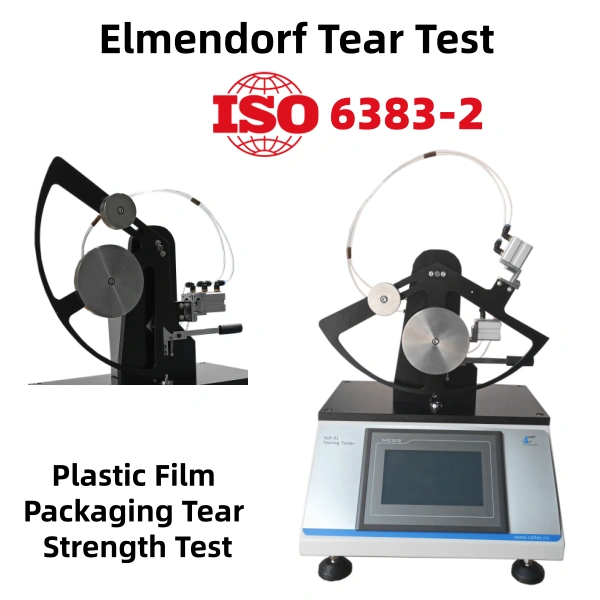
Key technical features include:
- PLC control with HMI touchscreen for intuitive operation
- Pneumatic specimen clamping to ensure uniform gripping force
- Automatic pendulum release for improved repeatability
- Integrated calibration weights for multiple force ranges
- Automatic statistical analysis of test data
- Optional professional software for advanced reporting and data management
- Optional micro-printer and RS-232 interface for data traceability
- Multiple pendulum capacities ranging from 200 gf to 6400 gf to accommodate a broad range of film tear strengths
These capabilities help laboratories reduce operator influence while improving repeatability and testing efficiency.
ISO 6383-2 remains one of the most important international standards for evaluating tear resistance in flexible plastic films. By using the standardized elmendorf method, manufacturers obtain reliable, repeatable measurements that support material development, production control, product comparison, and customer quality requirements.
When combined with tensile, puncture, impact, and seal strength testing, the elmendorf tear test of plastic film provides a comprehensive understanding of packaging durability and overall mechanical performance. Selecting a high-quality elmendorf tearing strength tester further improves data consistency, laboratory efficiency, and confidence in quality assurance programs.