
Introduction to Plastic Packaging Film Heat Seal Tester
Flexible packaging relies on strong and consistent heat seals to protect products from contamination, moisture, oxygen, and leakage. A Plastic Packaging Film Heat Seal Tester evaluates the heat sealability of plastic films, laminated films, and other heat-sealable materials by simulating the sealing process under controlled conditions according to methods such as ASTM F2029.
By controlling key parameters including temperature, pressure, and sealing time, the tester helps packaging engineers optimize sealing conditions and improve packaging reliability. Cell Instruments provides laboratory heat seal testing solutions, including the HST-01 Heat Seal Tester and HST-02 Heat Seal Tester, designed for evaluating films, laminates, polymers, and composite packaging materials.
What Is a Plastic Packaging Film Heat Seal Tester?
A Plastic Packaging Film Heat Seal Tester is a specialized laboratory device used to create controlled heat seals on packaging materials and evaluate their sealing characteristics.
During the test, the packaging film sample is placed between heated sealing jaws. The instrument applies a preset combination of temperature, pressure, and dwell time to reproduce the heat-sealing process used in packaging production lines. The resulting seal can then be evaluated for seal quality, seal strength, and sealing consistency.
Unlike production equipment, a laboratory heat seal tester allows engineers to study material behavior before mass production. It helps identify the optimal sealing window and prevents problems such as weak seals, excessive melting, film deformation, or sealing failure.
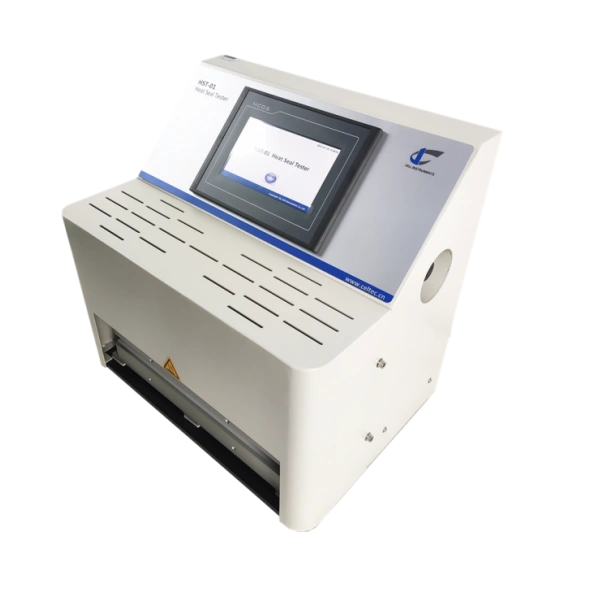
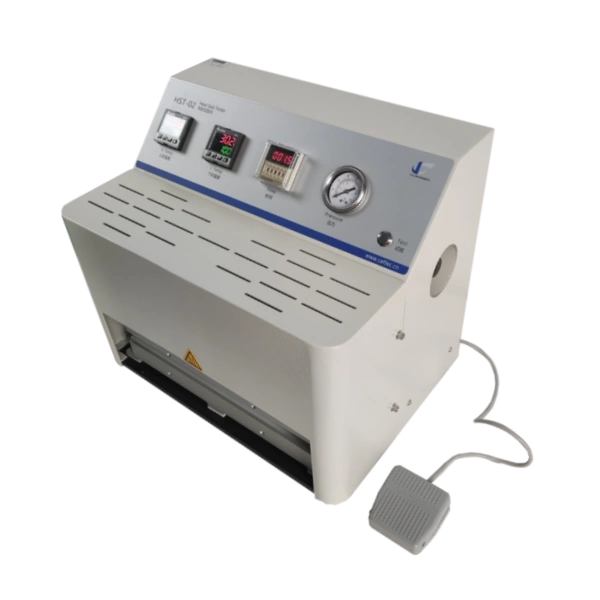
HST-02 Heat Seal Tester
Typical materials evaluated include:
| Material Type | Examples |
|---|---|
| Plastic Films | PE film, PP film, PVC film, PET film |
| Composite Films | PE/PE, PET/PE, PET/AL/PE laminates |
| Barrier Packaging Materials | Aluminum foil composite films, metallized films |
| Paper-Based Packaging | Plastic-coated paper, paper-plastic composites |
| Other Heat-Sealable Materials | Tubes, flexible packaging structures |
Why Is Heat Seal Testing Important?
Heat sealing is one of the most important processes in flexible packaging manufacturing. The quality of the seal directly affects package integrity, product protection, and consumer safety.
A poor sealing process may cause:
- Package leakage during transportation
- Contamination caused by seal failure
- Reduced shelf life
- Product damage and waste
- Increased production costs
Heat seal testing allows manufacturers to verify whether packaging materials can form reliable seals under specific processing conditions. According to ASTM F2029, heat seal testing is used to determine sealing conditions for flexible barrier materials by evaluating combinations of temperature, pressure, and sealing time.
The main benefits include:
1. Optimizing Heat Seal Parameters
Different packaging materials require different sealing conditions. Excessive temperature may damage films, while insufficient heat may create weak seals.
By testing different sealing conditions, engineers can determine:
- Optimal sealing temperature
- Suitable pressure range
- Required sealing duration
This helps establish a stable production process.
2. Improving Packaging Reliability
Consistent heat seal performance ensures that packages maintain integrity throughout manufacturing, transportation, and storage.
For industries such as food and pharmaceuticals, reliable sealing is essential because packaging failure may affect product safety.
3. Reducing Material Waste
Laboratory testing allows companies to identify sealing problems before production scale-up. Engineers can adjust material structures or machine settings early, reducing trial-and-error costs.
4. Supporting Quality Control and Compliance
Heat seal testing provides objective data for material qualification, supplier evaluation, and production quality control.
How Does a Plastic Packaging Film Heat Seal Tester Work?
A heat seal tester operates by reproducing the sealing process through controlled heat and pressure application.
The typical testing procedure includes:
1. Temperature Setup
The upper and lower sealing jaws are heated to the required temperature before testing.
2. Sample Placement
The plastic film or flexible packaging sample is positioned between the sealing jaws.
3. Pressure Application
The sealing jaws close and apply controlled pressure to the sample.
4. Heat Sealing Process
The instrument maintains the preset temperature, pressure, and sealing time.
5. Seal Evaluation
After sealing, the sample can be tested further, such as seal strength testing, leakage testing, or visual inspection.
The HST-01 and HST-02 Heat Seal Testers use controlled sealing conditions to evaluate how effectively packaging materials form seals.
Key Parameters in Heat Seal Testing
The performance of heat sealing mainly depends on three critical parameters:
| Parameter | Description | Influence on Seal Performance |
|---|---|---|
| Sealing Temperature | Heat applied during sealing | Determines melting and bonding of sealant layers |
| Sealing Pressure | Force applied by sealing jaws | Influences contact between material layers |
| Sealing Time | Duration of heat and pressure application | Determines seal formation quality |
A heat seal tester enables engineers to study the relationship between these parameters and identify the optimal sealing conditions for different packaging materials.
Applicable Materials and Industries
Plastic Packaging Film Heat Seal Tester is widely used across multiple industries.
| Industry | Typical Applications |
|---|---|
| Food Packaging | Snack bags, pouches, frozen food packaging, beverage packaging |
| Pharmaceutical Packaging | Medicine pouches, sterile packaging, medical supply packaging |
| Medical Devices | Flexible sterile barrier packaging |
| Cosmetics | Sachets, flexible tubes, cosmetic refill packaging |
| Packaging Material Manufacturing | Film development, laminate evaluation, quality control |
| Research Institutions | New material development and teaching laboratories |
Technical Specifications of HST-01 And HST-02
HST-01 Heat Seal Tester
| Parameter | Specification |
|---|---|
| Sealing Temperature | Ambient ~300℃ |
| Temperature Deviation | ±0.2℃ |
| Sealing Time | 0.1S ~ 9999S |
| Sealing Pressure | 0.15 ~ 0.7 MPa |
| Seal Jaw Size | 330 × 10 mm |
| Gas Pressure | 0.7 MPa |
| Port Size | Φ6 mm PU Hose |
| Power Supply | AC 220V 50Hz |
HST-02 Heat Seal Tester
| Parameter | Specification |
|---|---|
| Sealing Temperature | Ambient ~300℃ |
| Temperature Deviation | ±0.2℃ |
| Sealing Time | 0.1S ~ 9999S |
| Sealing Pressure | 0.15 ~ 0.7 MPa |
| Seal Jaw Size | 330 × 10 mm |
| Compressed Air | 0.7 MPa |
| Gas Port Size | Φ6 mm |
| Power Supply | AC 220V 50Hz |
Related Heat Seal Testing Standards
| Standard | Application |
|---|---|
| ASTM F2029 | Laboratory heat seal preparation and heat sealability evaluation |
| JIS Z 0238 | Heat sealing evaluation for packaging materials |
| YBB 00122003 | Pharmaceutical packaging material testing |
| QB/T 2358 | Flexible packaging seal strength related testing |
How to Choose the Right Heat Seal Tester?
When selecting a Plastic Packaging Film Heat Seal Tester, engineers should consider:
Material Compatibility
The tester should support the specific packaging materials being developed, including films, laminates, and coated materials.
Temperature Control Accuracy
Precise temperature regulation is essential because small temperature variations may significantly influence sealing performance.
Pressure Stability
Uniform pressure distribution ensures repeatable test results.
Custom Testing Requirements
Different packaging structures may require customized sealing jaws or special fixtures. The HST-02 supports customizable seal jaws to meet different testing applications.
Conclusion
A Plastic Packaging Film Heat Seal Tester provides packaging engineers with a reliable method to evaluate sealing performance before production. By controlling temperature, pressure, and sealing time, manufacturers can optimize packaging processes, improve seal reliability, reduce waste, and maintain consistent product quality, which is widely used in the food, pharmaceutical, medical, and packaging industries
For companies developing flexible packaging materials, heat seal testing is an essential quality control step to ensure packaging performance meets industry requirements. And reliable heat sealing performance is essential for producing safe and durable flexible packaging.
Cell Instruments provides professional heat seal testing solutions, including laboratory heat seal testers designed for plastic films, composite films, and packaging materials. Contact us to learn more about heat seal testing equipment and customized solutions.