
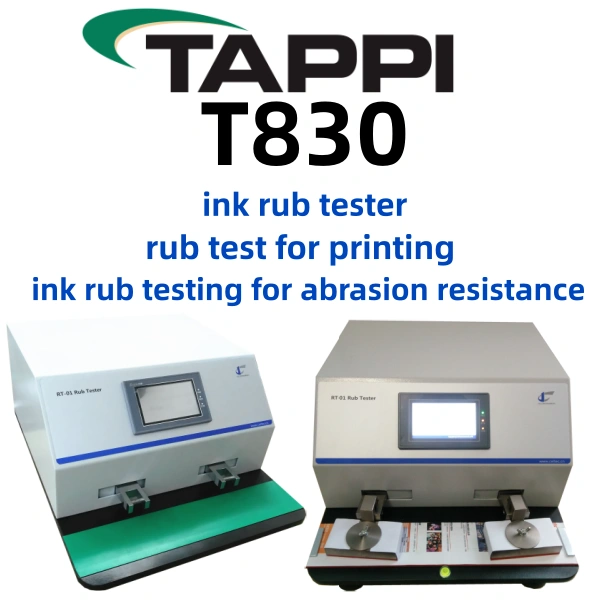
Printed information on packaging, labels, and paper products must remain clear and durable throughout production, transportation, storage, and consumer use. TAPPI T830 is a widely recognized test method used to evaluate the abrasion resistance of printed surfaces by simulating rubbing conditions that may cause ink wear, smearing, or transfer. The RT-01 Rub Tester provides a professional جهاز اختبار فرك الحبر solution designed to perform repeatable rub tests for printing applications, helping manufacturers verify print quality and improve product reliability.
For packaging manufacturers, printing companies, and quality control laboratories, ink rub testing for abrasion resistance is an essential evaluation process. It helps determine whether inks, coatings, varnishes, and printed graphics can withstand mechanical friction during handling. By identifying weak print performance before products reach the market, companies can reduce customer complaints, improve brand appearance, and maintain consistent quality.
What Is TAPPI T830 Rub Testing?
TAPPI T830 describes a method for evaluating the resistance of printed materials to abrasion caused by rubbing contact. The test simulates real-world conditions where printed surfaces experience friction against other materials, such as stacked packages, transportation equipment, shelves, or consumer handling.
During a rub test, a printed specimen is placed on the test platform, and a weighted rubbing material moves repeatedly across the printed surface. After a controlled number of cycles, the specimen is inspected to determine:
- Ink transfer onto the rubbing material
- Loss of printed image quality
- Smearing or color migration
- Coating or varnish durability
- Resistance of the printed layer to mechanical wear
The test provides valuable information about the durability of printing systems used on paperboard, cartons, labels, flexible packaging, and other printed substrates.
Why Ink Rub Testing for Abrasion Resistance Matters
Printed graphics are often the first point of interaction between a product and a customer. Poor abrasion resistance can negatively affect appearance, readability, and brand recognition.
محترف rub test for printing helps manufacturers evaluate:
Preventing Ink Smearing and Transfer
During transportation and storage, packages frequently contact other surfaces. If ink adhesion is insufficient, friction can cause visible smearing or color transfer.
Rub testing helps identify:
- Weak ink adhesion
- Insufficient drying or curing
- Poor coating compatibility
- Printing process variations
تحسين مظهر العبوة
Packaging products must maintain visual quality from manufacturing through final use. Abrasion testing confirms whether printed designs can withstand handling without fading or damage.
Supporting Quality Control
Manufacturers can use rub test results to:
- Compare different inks and coatings
- Verify supplier materials
- Optimize printing parameters
- Establish production quality standards
Reducing Product Returns
Packaging defects caused by damaged printing may lead to customer dissatisfaction. Early abrasion testing allows companies to detect potential problems before large-scale production.
Testing Principle of the TAPPI T830 Rub Tester
The RT-01 Rub Tester operates based on controlled reciprocating friction. The instrument applies a defined pressure between the printed sample and a rubbing receptor while maintaining controlled movement conditions.
The main testing principle includes:
- نموذج للتثبيت
The printed specimen is securely mounted on the testing platform. - Load Application
A selected rubbing weight applies consistent pressure to the contact area. - Controlled Rubbing Motion
The receptor moves repeatedly across the sample surface using an arc-stroke motion. - Visual and Performance Evaluation
After testing, users evaluate ink transfer, surface damage, or printing durability.
This controlled approach provides repeatable test conditions compared with manual rubbing evaluations.
How to Perform a Rub Test for Printing
نموذج TAPPI T830 rub testing procedure using an RT-01 Rub Tester includes the following steps:
| خطوة الاختبار | الوصف |
|---|---|
| تحضير العينة | Prepare printed samples with consistent size and conditioning |
| Sample Mounting | Fix the specimen onto the testing station |
| Weight Selection | Select 2 lb (908 g / 8.9 N) or 4 lb (1816 g / 17.8 N) load according to testing requirements |
| Parameter Setup | Set rubbing speed, cycle count, and optional heating temperature |
| Testing Process | The receptor performs reciprocating arc-stroke rubbing |
| تقييم النتائج | Inspect transferred ink, abrasion marks, and print quality changes |
The RT-01 allows users to configure testing conditions through an HMI touchscreen interface, improving operational efficiency and repeatability.
RT-01 Ink Rub Tester Technical Features
The RT-01 Rub Tester is designed for laboratories requiring accurate and flexible abrasion testing performance.
تشمل الميزات الرئيسية ما يلي:
Multiple Rub Test Modes
The instrument supports different application requirements:
- اختبار التتبيل الجاف
Evaluates abrasion resistance under normal dry conditions. - اختبار الفرك الرطب
Measures resistance when moisture affects printed surfaces. - اختبار الفرك الساخن
Evaluates coating and ink performance under elevated temperatures. (Heating customization available.) - Wet Bleed and Transfer Testing
Detects color migration and ink transfer under wet conditions. - Wet Smear Testing
Measures the tendency of printed surfaces to smear when exposed to moisture. - Functional Rub Testing
Custom configurations can simulate specific customer handling conditions.
معلمات الاختبار القابلة للتعديل
The RT-01 provides flexible control of:
| المعلمة | المواصفات |
|---|---|
| خيارات الوزن | 908 غرام (2 رطل) / 8.9 نيوتن؛ 1816 غرام (4 رطل) / 17.8 نيوتن |
| نطاق السرعة | 20–120 نبضة في الدقيقة، قابلة للتعديل |
| عدد العينات | 1–2 |
| نصف قطر الدوران | 185 ملم |
| طول القوس | 57 ملم ± 1 ملم |
| الأبعاد | 390 × 480 × 220 ملم |
| مصدر الطاقة | 110–220 فولت، 50/60 هرتز |
These adjustable parameters allow laboratories to perform standardized testing while adapting the instrument for different materials and applications.
Applications of Ink Rub Tester in Different Industries
إن جهاز اختبار فرك الحبر is widely used in industries where printed surface durability directly affects product quality.
صناعة التغليف
Packaging manufacturers use rub testing to evaluate:
- العلب الكرتونية القابلة للطي
- Corrugated packaging graphics
- Food packaging printing
- تغليف المستحضرات الصيدلانية
- Consumer product boxes
The test ensures printed information remains readable during logistics and retail handling.
صناعة الطباعة
Printing companies use abrasion testing to verify:
- Ink formulation performance
- Printing process stability
- Coating compatibility
- Finishing quality
تصنيع الملصقات
Labels often experience friction during:
- Roll conversion
- النقل
- Application processes
Rub testing helps confirm that graphics and barcodes remain intact.
التغليف الصيدلاني والطبي
Printed information such as:
- Batch numbers
- Expiration dates
- Instructions
- Regulatory markings
must remain legible throughout the product lifecycle. Abrasion testing supports compliance and traceability requirements.
Materials Suitable for TAPPI T830 Rub Testing
The RT-01 can evaluate various printed materials, including:
- ورقة
- الورق المطلي
- الورق المقوى
- العلب الكرتونية القابلة للطي
- الورق المقوى المموج
- الملصقات
- أغشية التغليف المرنة
- ألواح بلاستيكية مطبوعة
- المواد المصفحة
- Varnished surfaces
Different substrates may exhibit different abrasion resistance due to surface texture, ink adhesion, coating properties, and finishing processes.
المعايير ذات الصلة باختبار الاحتكاك
The RT-01 Rub Tester supports testing methods commonly associated with printed material durability evaluation, including:
| قياسي | التطبيق |
|---|---|
| TAPPI T830 | Abrasion resistance evaluation of printed materials |
| ASTM D5264 | مقاومة المواد المطبوعة للتآكل |
| ASTM F1571 | Abrasion testing applications for printed packaging |
| ASTM F2497 | Printing durability evaluation applications |
Standards may vary depending on industry requirements, material types, and customer quality specifications.
How to Select the Right Rub Tester
When selecting an abrasion testing instrument, laboratories should consider:
Testing Standards
Confirm that the instrument supports required methods such as TAPPI T830 or ASTM-based procedures.
Material Applications
Different materials may require different loads, speeds, and test accessories.
Test Flexibility
Advanced laboratories may require:
- Multiple rubbing modes
- Adjustable speed control
- Temperature-controlled testing
- تركيبات مخصصة
Data Reliability
A professional testing system should provide:
- شروط اختبار قابلة للتكرار
- Stable mechanical movement
- سهولة التشغيل
- Consistent evaluation results
The RT-01 Rub Tester combines standardized testing capability with customization options to support diverse industrial requirements.
Improving Quality Control with TAPPI T830 Testing
Implementing TAPPI T830 testing within production quality systems helps companies create measurable print durability standards. Instead of relying only on visual inspection, manufacturers can use quantitative testing methods to compare materials, validate suppliers, and monitor production consistency.
For packaging and printing companies, reliable abrasion testing supports:
- Better product appearance
- Improved customer satisfaction
- Reduced waste
- Faster material selection
- Stronger quality assurance systems
محترف ink rub testing for abrasion resistance process provides essential technical data for improving printed product performance.
الخاتمة
Reliable print durability testing helps manufacturers prevent ink failure, improve packaging quality, and maintain consistent product appearance. Cell Instruments provides professional rub testing solutions based on TAPPI T830, ASTM methods, and customized customer requirements. The RT-01 Rub Tester supports standard abrasion evaluation as well as specialized testing configurations for different industries and materials. Contact our technical team to learn how an advanced ink rub tester can support your quality control, R&D, and production validation processes.