
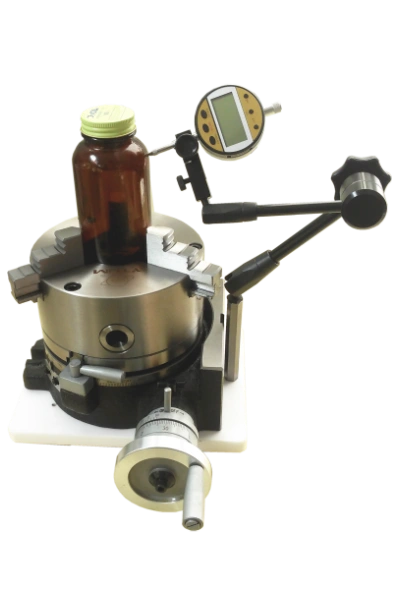
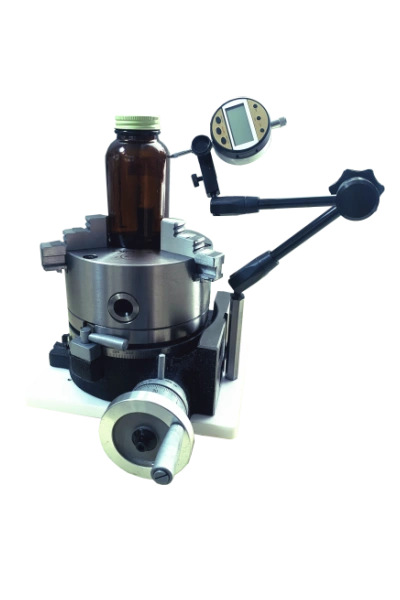
A bottle perpendicularity tester is a precision testing instrument designed to evaluate the vertical alignment, perpendicularity, and axis deviation of bottle containers. It is widely used by manufacturers, quality control laboratories, and research organizations in industries such as food packaging, cosmetics, pharmaceuticals, and beverages to ensure bottles maintain proper upright positioning and dimensional consistency.
During bottle production, even small deviations between the bottle axis and the vertical reference line can affect filling operations, capping performance, labeling accuracy, transportation stability, and consumer appearance. A reliable bottle perpendicularity tester provides quantitative measurement data to help engineers identify manufacturing variations and maintain consistent container quality.
The PER-01 Perpendicularity Tester from Cell Instruments is designed as a practical perpendicularity measuring instrument for bottles, vials, and similar cylindrical containers. By measuring the deviation between the bottle mouth and the vertical axis during rotation, the instrument helps users evaluate container straightness with high precision and repeatability.
Why Bottle Perpendicularity Measurement Is Important
Bottle perpendicularity is a critical dimensional quality parameter in container manufacturing. A bottle that does not stand vertically may indicate problems during molding, forming, cooling, or material distribution.
Poor vertical alignment can create several production and application issues:
- Unstable bottle positioning: Containers may tilt or wobble during storage, transportation, and display.
- Filling and capping problems: Misalignment may affect the contact between bottle openings and filling or sealing equipment.
- Labeling defects: Automated labeling systems require accurate bottle positioning for consistent label placement.
- Reduced production efficiency: Excessive deviation can increase rejection rates and require additional quality inspections.
- Appearance quality concerns: Consumers often associate straight, well-aligned containers with higher product quality.
For industries producing large quantities of bottles, measuring perpendicularity helps establish reliable quality control procedures and ensures that containers meet customer specifications.
What Is a Bottle Perpendicularity Tester?
A bottle perpendicularity tester measures the deviation between the actual bottle axis and the ideal vertical reference axis. The instrument determines how much the bottle mouth or neck position shifts when the container rotates around its central axis.
Unlike visual inspection methods, a precision tester provides numerical results that allow manufacturers to compare measurements against internal specifications or industry requirements.
The instrument is commonly known by several related names, including:
- Bottle deviation tester
- Coaxial tester
- Coaxiality tester
- Circle runout tester
- Bottle verticality tester
- Container perpendicularity measuring instrument
Although terminology varies among industries, these instruments share the same purpose: evaluating the alignment accuracy of containers.
Testing Principle of Perpendicularity Measurement
The working principle of the PER-01 bottle perpendicularity tester is based on rotational measurement and dial gauge displacement detection.
During testing, the bottle is fixed vertically on a rotating platform. The measuring probe contacts the bottle opening or designated measurement point. When the bottle rotates through 360 degrees, the probe detects the maximum and minimum displacement caused by the deviation of the bottle axis.
The vertical axis deviation is calculated using the following principle:
Verticality deviation = (Maximum reading − Minimum reading) ÷ 2
This calculation eliminates the influence of the reference position and provides an accurate representation of the bottle’s perpendicularity error.
The measurement process provides a simple and reliable method for evaluating bottle alignment without requiring complex calculations or advanced operator training.
Verticality Test Method for Glass Bottles and Other Containers
Το verticality test method for glass bottles typically follows a rotational measurement approach. Although requirements may vary depending on container type and industry specifications, the general procedure includes the following steps:
1. Προετοιμασία δείγματος
Select a representative bottle sample and ensure that the container is clean and free from visible defects. The bottle dimensions should meet the measuring range requirements of the instrument.
2. Bottle Installation
Place the bottle securely on the rotating platform. Proper positioning ensures that the bottle remains stable throughout the measurement process.
3. Probe Adjustment
Adjust the measuring probe until it contacts the bottle mouth or specified measurement location with suitable pressure.
4. Full Rotation Measurement
Rotate the bottle through 360 degrees while observing the dial gauge movement. The instrument records the highest and lowest displacement values.
5. Result Calculation
Calculate the vertical axis deviation according to the difference between maximum and minimum readings.
Αυτό verticality test method for glass bottles can also be applied to plastic bottles, pharmaceutical containers, and other cylindrical packaging products when suitable fixtures are used.
Universal Bottle Perpendicularity Test Applications
A universal bottle perpendicularity test provides flexibility for measuring different container designs, including various diameters, heights, and materials.
The PER-01 Perpendicularity Tester supports a wide range of applications through adjustable measurement components and optional customization.
Typical tested products include:
| Container Type | Common Applications |
|---|---|
| Glass bottles | Beverage, pharmaceutical, cosmetic packaging |
| PET bottles | Water, beverage, household products |
| Πλαστικά δοχεία | Chemical and daily-use packaging |
| Vials | Medical and laboratory packaging |
| Small cylindrical containers | Research and quality inspection |
The ability to test different bottle structures makes the instrument suitable for manufacturers producing multiple container formats.
PER-01 Perpendicularity Tester Technical Features
The PER-01 is developed to provide accurate and efficient bottle alignment measurement for laboratory and production quality control environments.
High Measurement Accuracy
The instrument provides high-resolution readings with optional accuracy levels of 0.01 mm or 0.001 mm, allowing users to detect small deviations in bottle geometry.
Stable Sample Rotation
A controlled rotating platform ensures smooth and consistent sample movement during measurement. Stable rotation improves repeatability and reduces operator influence.
Adjustable Measuring Probe
The probe position can be conveniently adjusted according to different bottle sizes and testing requirements, improving measurement flexibility.
Wide Sample Compatibility
The tester can accommodate bottles with different diameters and heights:
| Παράμετρος | Προδιαγραφές |
|---|---|
| Sample diameter | 5 mm–145 mm (customizable) |
| Test range | 0–12.7 mm (customizable) |
| Division value | 0.01 mm / 0.001 mm optional |
| Measurable height | 15 mm–300 mm (customizable) |
Data Management Capability
The optional PC Excel data export function allows users to record, analyze, and manage test results efficiently, supporting laboratory documentation and quality traceability.
How to Choose a Perpendicularity Measuring Instrument
Επιλογή του κατάλληλου perpendicularity measuring instrument depends on several factors:
Container Size Range
The instrument should match the diameter and height range of the bottles being tested. Manufacturers producing different bottle formats should consider adjustable or customized measurement solutions.
Required Measurement Accuracy
High-precision applications such as pharmaceutical vials may require instruments with finer resolution, while general packaging applications may use standard measurement accuracy.
Testing Frequency
For laboratories performing occasional inspections, manual operation may be sufficient. For production environments requiring frequent measurements, automated or customized systems may provide higher efficiency.
Industry Standards
The selected equipment should support applicable testing standards and customer requirements to ensure reliable quality evaluation.
Standards Related to Bottle Perpendicularity Testing
Bottle perpendicularity requirements are commonly associated with packaging dimensional inspection standards. The PER-01 supports testing according to relevant industry specifications, including:
- ISO 9008
- GB 8452
- QB 2357
- QB/T 1868
- YBB 00192003
Μεταξύ αυτών των προτύπων, ISO 9008 provides guidance related to container dimensional characteristics and testing requirements. Manufacturers can use standardized measurement procedures to maintain consistency between production batches and ensure compliance with customer expectations.
Bottle Perpendicularity Testing in Different Industries
Συσκευασία τροφίμων και ποτών
Bottle manufacturers and beverage producers use perpendicularity testing to ensure containers remain stable during filling, packaging, transportation, and shelf display.
Συσκευασία φαρμακευτικών προϊόντων
Glass vials and pharmaceutical containers require strict dimensional control because deviations may influence sealing, handling, and automated packaging processes.
Συσκευασίες καλλυντικών
Premium cosmetic containers require excellent appearance and alignment quality. Perpendicularity testing helps maintain consistent product presentation.
Εργαστήρια ποιοτικού ελέγχου
Third-party laboratories and research facilities use perpendicularity testers to verify supplier quality and perform comparative evaluations.
Benefits of Using a Bottle Perpendicularity Tester for Quality Control
Implementing a bottle perpendicularity tester in quality control processes provides several advantages:
- Provides objective numerical measurement instead of visual judgment
- Improves consistency between operators and production batches
- Helps identify molding and forming problems early
- Supports supplier quality evaluation
- Reduces packaging failures during filling and transportation
- Creates traceable inspection records
For manufacturers seeking stable production quality, perpendicularity measurement is an important part of comprehensive container testing.
Closing Summary
Ένα αξιόπιστο bottle perpendicularity tester helps manufacturers evaluate container alignment, improve production consistency, and ensure packaging performance. By using rotational measurement technology, the PER-01 provides accurate and repeatable results for glass bottles, plastic bottles, vials, and other cylindrical containers.
As a professional perpendicularity measuring instrument, it supports applications across food, pharmaceutical, cosmetic, and packaging industries. Combined with standards such as ISO 9008 and flexible customization options, the tester provides an effective solution for modern container quality control requirements.
Cell Instruments provides professional bottle perpendicularity testing solutions with precise measurement technology, customizable fixtures, and laboratory-focused designs. Whether you need standard container inspection or specialized testing requirements, our team can provide suitable equipment solutions to support your quality control and product development processes.


