
Overview of Ink Rub Resistance Tester
The ink rub resistance tester is designed to evaluate the abrasion resistance, ink adhesion, and durability of printed materials, labels, packaging, and coated surfaces. By simulating repeated rubbing during transportation, handling, and consumer use, this testing equipment helps manufacturers determine the rub resistance of printed materials and prevent problems such as ink smearing, color transfer, fading, and coating failure.
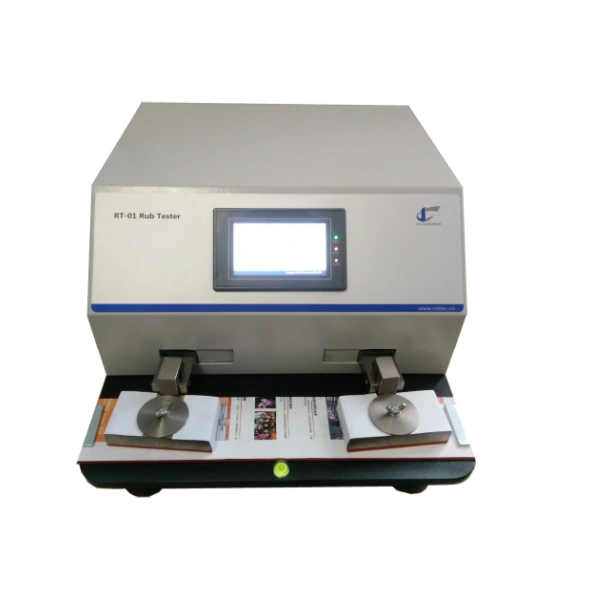
For printing companies, packaging manufacturers, and quality control laboratories, reliable rub testing provides valuable data to improve product quality and ensure printed surfaces maintain appearance and performance throughout their service life. The RT-01 Rub Tester provides a controlled testing method for dry rub, wet rub, heated rub, and transfer evaluation, supporting applications related to ASTM D5264, TAPPI T830, and other industry requirements.
What Is an Ink Rub Resistance Tester?
Üks ink rub resistance tester is a laboratory instrument that measures the ability of printed surfaces to resist abrasion caused by repeated rubbing motion. The equipment applies a controlled force between a printed specimen and a rubbing material, then evaluates the resulting damage, ink transfer, color change, or surface deterioration.
The test simulates real-world conditions such as:
- Package-to-package friction during transportation
- Label contact during handling
- Folding and stacking operations
- Moisture exposure during use
- Mechanical contact with other surfaces
The RT-01 Rub Tester uses reciprocating arc-stroke movement to create consistent rubbing conditions. Users can select different test parameters, including rubbing speed, stroke count, and applied weight, to reproduce specific application requirements.
Why Ink Rub Resistance Testing Is Important
Printed information and graphics are essential components of modern packaging, labels, and commercial products. However, printed surfaces often experience friction during production, stacking, transportation, and daily handling. Without sufficient abrasion resistance, ink layers may become damaged, affecting product appearance and consumer confidence.
Üks ink rub tester for rub resistance helps manufacturers verify whether printing inks, coatings, and substrates can withstand mechanical wear under controlled conditions.
Key quality benefits include:
- Preventing ink smearing and transfer
The test identifies whether printed ink can migrate or transfer to another surface when subjected to repeated friction. - Evaluating printing durability
Manufacturers can compare different inks, coatings, printing processes, and substrates to select the most reliable combination. - Improving packaging quality control
Rub testing helps reduce customer complaints caused by damaged labels, unreadable information, or poor visual appearance. - Supporting product development
R&D teams can optimize coating formulations, varnishes, and printing parameters based on measured abrasion resistance.
For industries where printed information affects product identification, regulatory compliance, or brand image, rub resistance testing is an important part of quality assurance.
How Does the Sutherland Rub Test Work?
The Sutherlandi hõõrdumiskatse is one of the most widely recognized methods for evaluating the abrasion resistance of printed materials. It measures how well printed ink or coatings withstand repeated rubbing under a controlled load.
Katsetamise ajal:
- Sample preparation
The printed specimen is securely mounted on the test platform. - Load selection
A weighted receptor applies controlled pressure to the test surface. Common weights include:
| Weight Option | Jõud |
|---|---|
| 2 lb | 908 g / 8,9 N |
| 4 lb | 1,816 g / 17.8 N |
- Test parameter setup
The operator selects rubbing speed, cycle number, and other conditions through the touchscreen interface. - Reciprocating rubbing movement
The receptor moves repeatedly across the sample using a controlled arc-stroke motion. - Result evaluation
After testing, users examine ink loss, transfer marks, color change, smearing, or coating damage.
This controlled approach allows laboratories to compare materials objectively and establish consistent quality standards.
Ink Rub Tester Testing Methods and Applications
The RT-01 supports multiple rub testing methods to evaluate different durability requirements.
| Katse meetod | Eesmärk | Tüüpilised rakendused |
|---|---|---|
| Dry Rub Test | Measures abrasion resistance under dry conditions | Packaging, labels, printed cartons |
| Wet Rub Test | Evaluates durability when moisture is present | Food packaging, beverage labels |
| Heated Rub Test | Tests ink and coating performance at elevated temperatures | Heat-sensitive coatings, specialty printing |
| Wet Bleed / Transfer Test | Measures ink migration and transfer tendency | Flexible packaging and labels |
| Wet Smear Test | Evaluates resistance to smearing on wet surfaces | Consumer packaging and printed products |
| Functional Rub Test | Simulates customized real-use conditions | Special applications requiring customized fixtures |
Typical industries using rub resistance testing include:
- Paindlike pakendite tootjad
- Paper and cardboard packaging producers
- Label printing companies
- Ravimipakendite tarnijad
- Food and beverage packaging manufacturers
- Printing and coating industries
- Kvaliteedikontrolli laborid
Testing Principle and Technical Parameters
The ink rub resistance tester evaluates material durability by applying controlled friction between two surfaces. The amount of ink removed, transferred, or visually damaged after rubbing indicates the abrasion resistance performance.
The RT-01 Rub Tester provides stable mechanical movement and adjustable testing conditions.
| Parameeter | Tehnilised andmed |
|---|---|
| Testing Weight | 908 g (2 lb) / 1,816 g (4 lb) |
| Testing Speed | 20–120 lööki minutis, reguleeritav |
| Proovide arv | 1–2 |
| Pöörlemisraadius | 185 mm |
| Kaare pikkus | 57 mm ± 1 mm |
| Movement Type | Edasi-tagasi liikuv kaare liigutus |
| Mõõtmed | 390 × 480 × 220 mm |
| Toiteallikas | 110–220 V, 50/60 Hz |
The adjustable speed and load settings allow laboratories to perform repeatable testing for different printed materials and coating systems.
Standards Related to Ink Rub Resistance Testing
Professional laboratories often perform rub testing according to internationally recognized methods. The RT-01 supports several industry standards, including:
| Standard | Kirjeldus |
|---|---|
| ASTM D5264 | Trükimaterjalide kulumiskindluse standardne katsemeetod |
| TAPPI T830 | Rub resistance testing method for printed surfaces |
| ASTM F1571 | Test method related to printed packaging materials |
| ASTM F2497 | Evaluation of printed materials and labeling performance |
| FINAT FTM 27 | Label industry rub resistance testing |
| JIS K 5701 | Printing ink related testing method |
These standards help ensure consistent test procedures and reliable comparison between different materials, inks, and production processes.
Choosing the Right Ink Rub Tester for Quality Control
When selecting an ink rub resistance tester, laboratories should consider several factors:
Testing flexibility
Different industries require different test conditions. Adjustable load, speed, and cycle settings provide better compatibility with various materials.
Repeatability and accuracy
Stable mechanical movement and precise control are essential for obtaining reliable abrasion resistance results.
Application requirements
Packaging, labels, and coated paper may require different rub test methods, including dry, wet, or heated testing.
Customization capability
Special applications may require customized fixtures, heating systems, or multi-condition testing solutions.
Cell Instruments provides professional material testing solutions, including standard rub testers and customized configurations for specific quality control requirements.
Kokkuvõte
The ink rub resistance tester is a laboratory instrument used to evaluate the durability of printed surfaces against abrasion, rubbing, and ink transfer. It simulates real handling conditions to measure resistance to smearing, fading, coating damage, and color migration. The equipment supports dry rub, wet rub, heated rub, and customized functional testing for packaging, labels, paper products, and printed materials. With adjustable speed, load, and testing cycles, it provides reliable performance evaluation for printing quality control and material development.
Cell Instruments provides professional ink rub resistance tester solutions designed for packaging, printing, and quality inspection applications, with customizable configurations available for specialized testing needs. Contact our technical team to learn more about rub testing equipment, application solutions, and how our instruments can support your material evaluation requirements.