
Paper products are expected to withstand handling, converting, transportation, and end-use without unexpected tearing. ISO 1974 provides the internationally recognized procedure for determining the tear resistance test of paper using the pendulum-based Elmendorf tear test method. The standard enables manufacturers, converters, laboratories, and quality assurance professionals to evaluate how easily a pre-cut sheet of paper continues to tear under controlled conditions.
Whether producing packaging paper, printing paper, labels, medical packaging substrates, or specialty industrial papers, understanding ISO 1974 helps manufacturers maintain consistent product quality, optimize material selection, and meet customer performance requirements. This guide explains the testing principle, procedure, applications, result interpretation, and equipment considerations from a practical laboratory perspective.
What Is ISO 1974?
ISO 1974 specifies a standardized method for determining the tear resistance of paper by measuring the force required to propagate an existing tear through a specified distance.
Unlike tensile testing, which measures resistance to breaking under continuous pulling, the tear resistance test of paper evaluates a material’s ability to resist the growth of an existing notch. Since many paper failures begin from small cuts, edge damage, or perforations, tear resistance is often a better indicator of real-world durability.
The standard adopts the well-established Elmendorf tear test method, originally developed by Armin Elmendorf, which remains one of the most widely accepted approaches for paper and flexible sheet materials worldwide.
Miksi repäisylujuus on tärkeää?
Tear resistance directly influences product performance during manufacturing and use.
Manufacturers rely on ISO 1974 testing to:
- Reduce package failures during shipping
- Improve converting efficiency on high-speed production lines
- Optimize paper formulations
- Verify supplier consistency
- Compare different grades of paper
- Support quality assurance programs
- Vastata asiakkaan vaatimuksiin
For many applications, high tensile strength alone cannot prevent failure if tear resistance is insufficient.
Testing Principle of the Elmendorf Tear Test Method
The Elmendorf tear test method measures the energy required to continue tearing a specimen after an initial slit has been introduced.
During testing:
- A standard specimen is prepared with a precisely defined pre-cut.
- The specimen is clamped vertically between two jaws.
- A pendulum is released from a fixed height.
- The pendulum propagates the tear through the remaining portion of the specimen.
- Energy loss during tearing is converted into tear resistance.
Because the measurement is based on energy rather than simple pulling force, the method provides highly repeatable results for paper quality evaluation.
Test Procedure According to ISO 1974
Although laboratories should always follow the complete standard, the general testing workflow includes the following steps.
1. Specimen Preparation
Test specimens are cut to specified dimensions.
Key requirements include:
- Uniform specimen size
- Clean edges
- Standardized pre-cut
- Proper conditioning before testing
Paper is typically conditioned under standard laboratory atmospheric conditions before testing to minimize moisture-related variation.
2. Instrument Calibration
Ennen testausta:
- Select the appropriate pendulum capacity
- Verify calibration
- Check zero position
- Inspect clamps
Proper calibration ensures measurement accuracy throughout the testing process.
3. Specimen Mounting
The specimen is securely clamped into the Elmendorf-type tear tester, ensuring:
- Oikea kohdistus
- No wrinkles
- Uniform clamping pressure
Improper mounting may introduce significant testing errors.
4. Pendulum Release
The pendulum is released automatically or manually depending on the equipment design.
As the pendulum swings, it completes the tear while losing kinetic energy.
5. Data Recording
The tester calculates tear resistance from the measured energy loss.
Modern digital instruments automatically provide:
- Individual results
- Average values
- Statistical calculations
- Data storage
- Printable reports
Typical Test Parameters
| Parametri | Typical Value |
|---|---|
| Testausmenetelmä | Pendulum tear |
| Standardi | ISO 1974 |
| Initial Cut | Standardized notch |
| Mittaus | Tear energy |
| Output Units | mN, gf, tear index (optional) |
| Applicable Materials | Paperi ja pahvi |
Applicable Materials
ISO 1974 is suitable for numerous paper products, including:
- Printing paper
- Writing paper
- Kraft-paperi
- Pakkauspaperi
- Sack paper
- Päällystetty paperi
- Päällystämätön paperi
- Tissue base paper
- Specialty industrial paper
- Label stock
- Medical packaging paper
- Paperboard (within applicable range)
Industries Using ISO 1974 Testing
The tear resistance test of paper is widely used in:
- Packaging manufacturing
- Paper mills
- Printing companies
- Label production
- Elintarvikepakkaukset
- Lääkkeiden pakkaukset
- Lääkinnällisten laitteiden pakkaukset
- Laadunvalvontalaboratoriot
- Yliopistot
- Tutkimuslaitokset
These industries depend on consistent tear resistance to maintain product reliability and customer satisfaction.
Factors Affecting Tear Resistance
Several material characteristics influence tear resistance measurements.
Fiber Properties
Longer fibers generally improve tear resistance because they require greater energy to separate.
Basis Weight
Heavier papers often exhibit higher tear strength, although fiber bonding also plays a major role.
Fiber Orientation
Machine direction (MD) and cross direction (CD) frequently produce different tear values due to fiber alignment during papermaking.
Moisture Content
Paper moisture significantly affects mechanical performance, making specimen conditioning essential before testing.
Surface Treatments
Coatings, laminations, and chemical treatments may alter tear propagation behavior.
Understanding Test Results
Interpreting results requires considering the intended application.
Higher tear resistance is generally desirable for:
- Shipping bags
- Teollisuuspakkaukset
- Heavy-duty wrapping papers
- Medical sterilization packaging
- Protective papers
Lower tear resistance may be acceptable—or even preferred—for:
- Easy-open packaging
- Controlled-tear products
- Certain disposable paper products
Laboratories often compare measured values with:
- Customer specifications
- Historical production data
- Supplier acceptance criteria
- Sisäiset laatustandardit
Trend analysis is often more valuable than a single measurement when monitoring production consistency.
ISO 1974 Compared with Related Tear Standards
| Standardi | Materiaali | Testausmenetelmä | Typical Application |
|---|---|---|---|
| ISO 1974 | Paperi | Elmendorf pendulum | Paper quality control |
| ASTM D689 | Paperi | Elmendorf | Paper testing |
| ISO 6383-1 | Plastic film | Elmendorf | Joustavat pakkauskalvot |
| ASTM D1922 | Plastic film | Elmendorf | Plastic film tear resistance |
| ASTM D1424 | Tekstiilit | Elmendorf | Fabric tear testing |
Although these standards share the same fundamental pendulum principle, specimen dimensions, calculation methods, and applicable materials differ.
Choosing an Elmendorf-Type Tear Tester
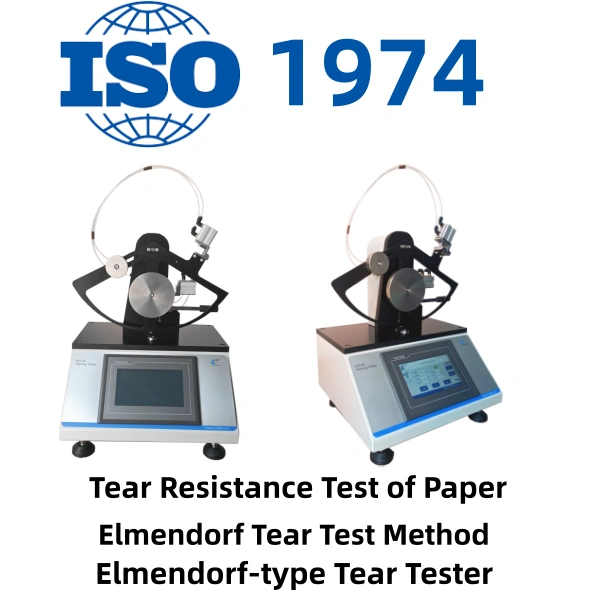
Selecting a reliable Elmendorf-type tear tester is essential for obtaining repeatable and standards-compliant results.
Tärkeitä huomioitavia seikkoja ovat muun muassa:
- Appropriate pendulum capacities
- Automaattinen heilurin vapautus
- Näytteen vakaa kiinnitys
- Digital result calculation
- Tilastollinen analyysi
- Kalibroinnin tarkistus
- Tietojen vientitoiminto
- Compliance with multiple international standards
Modern laboratories increasingly prefer computerized systems that reduce operator influence while improving traceability and reporting efficiency.
Cell Instruments SLD-01 Elmendorf-Type Tear Tester Solution
For laboratories performing ISO 1974 and other international tear resistance standards, the SLD-01 Elmendorf-Type Tear Tester from Cell Instruments provides a professional solution based on the proven Elmendorf pendulum principle.
Tärkeimpiä ominaisuuksia ovat:
- PLC control with intuitive HMI touchscreen
- Industrial pneumatic specimen clamping for consistent gripping
- Automaattinen heilurin vapautus, joka minimoi käyttäjän aiheuttamat vaihtelut
- Multiple pendulum capacities: 200, 400, 800, 1600, 3200, and 6400 gf
- Integrated calibration weights for routine accuracy verification
- Automaattiset tilastolliset laskelmat
- Valinnainen RS-232-liitäntä ja mikrotulostin
- Optional software for advanced data analysis and report generation
- Paper-specific output units, including mN and tear index where applicable
Beyond standard testing instruments, Cell Instruments also provides customized fixtures, automated testing systems, and tailored material testing solutions to address specialized laboratory and production requirements.
Best Practices for Reliable ISO 1974 Testing
To improve repeatability and reduce testing variability:
- Condition specimens under standard laboratory conditions.
- Test both machine direction (MD) and cross direction (CD).
- Use sharp specimen cutting tools.
- Verify pendulum calibration regularly.
- Avoid damaged or folded specimens.
- Perform sufficient replicate tests for statistical confidence.
- Maintain consistent clamping pressure.
- Record environmental conditions during testing.
Following these practices helps laboratories generate dependable results suitable for quality control, supplier qualification, product development, and regulatory documentation.
Päätelmä
ISO 1974 remains the international benchmark for evaluating the tear resistance of paper using the proven Elmendorf tear test method. By measuring the energy required to propagate an existing tear, the standard provides meaningful insight into the durability of paper products across packaging, printing, medical, and industrial applications.
When combined with a high-quality Elmendorf-type tear tester, standardized specimen preparation, and proper laboratory procedures, ISO 1974 testing supports reliable quality control, product optimization, supplier evaluation, and continuous process improvement throughout the paper manufacturing and converting industries.