
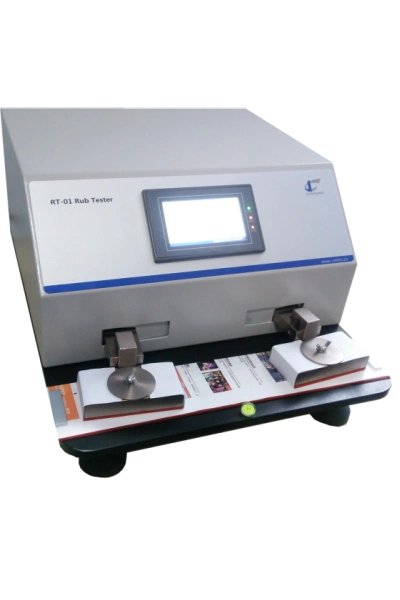
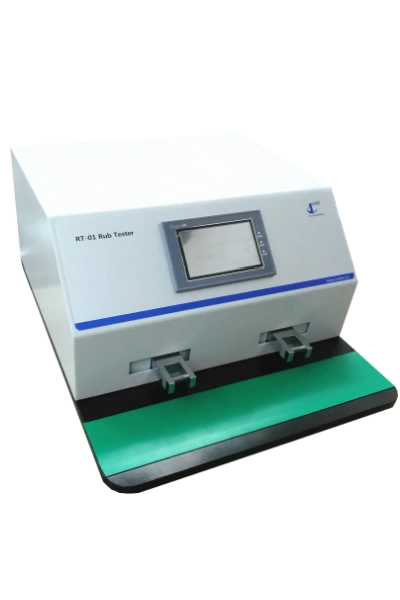
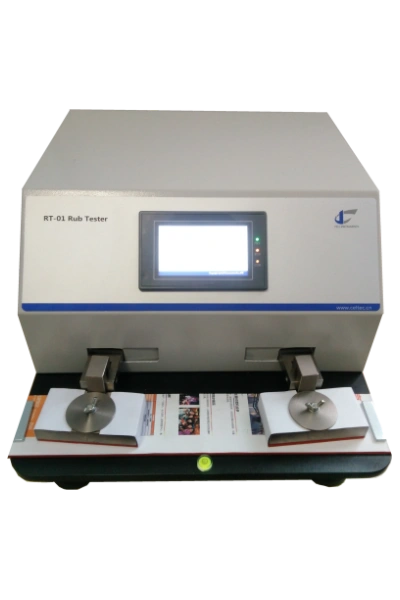
Printed packaging, labels, cartons, and coated materials must maintain their appearance and readability throughout production, transportation, storage, and consumer use. The ink rub tester provides a reliable method to evaluate whether printed inks, coatings, and surface finishes can withstand repeated friction without smearing, fading, transferring, or losing adhesion. By simulating real-world rubbing conditions, this testing equipment helps manufacturers verify print durability and improve product quality.
The RT-01 Rub Tester from Cell Instruments is designed for professional abrasion resistance evaluation based on widely recognized methods, including ASTM D5264, TAPPI T830, og sutherland rub test principle. It supports dry rub, wet rub, heated rub, wet bleed, and smear evaluation for printed materials and coated substrates. With adjustable test speed, selectable loads, touchscreen operation, and customizable configurations, the instrument provides laboratories and quality control teams with an efficient solution for assessing print and surface performance.
What Is an Ink Rub Tester?
En ink rub tester is a laboratory instrument used to measure the resistance of printed ink, coatings, varnishes, and surface treatments against mechanical abrasion. The test evaluates how well printed surfaces maintain their visual quality when subjected to repeated rubbing forces.
During daily use, printed products experience continuous friction. Examples include:
- Folding cartons rubbing against each other during transportation
- Labels contacting packaging equipment during manufacturing
- Flexible packaging surfaces rubbing during filling and handling
- Printed instructions or markings being touched repeatedly by users
Without sufficient rub resistance, printed information may become unclear, causing quality complaints, brand damage, or regulatory concerns.
The ink rub tester recreates these conditions by moving a weighted receptor across a test specimen with controlled pressure and motion. After a defined number of cycles, operators evaluate ink transfer, color loss, smearing, or coating damage.
Why Rub Resistance Testing Is Important
Print durability is a key quality indicator for packaging and printed products. A visually attractive package must also maintain its appearance throughout its expected lifecycle.
Rub resistance testing helps manufacturers:
| Quality Objective | Testing Benefit |
|---|---|
| Prevent ink smearing | Identifies weak ink adhesion before products reach customers |
| Improve packaging appearance | Ensures graphics remain clear after handling |
| Verify coating performance | Evaluates varnishes, protective layers, and surface finishes |
| Reduce product complaints | Detects printing problems during production control |
| Støtte til leverandørkvalifisering | Provides measurable performance data for inks and substrates |
For industries such as food packaging, pharmaceuticals, cosmetics, and consumer goods, print quality directly influences brand recognition and regulatory compliance. A damaged label or unreadable marking may create serious operational issues.
ASTM D5264 and TAPPI T830 Standard Test Methods for Rub Resistance
Den ASTM D5264 standard is one of the most commonly referenced methods for evaluating abrasion resistance of printed materials using a reciprocating rubbing motion. It provides guidance for measuring the resistance of printed surfaces against rubbing under controlled laboratory conditions.
Den TAPPI T830 method is widely used in the paper and packaging industry for determining the rub resistance of printed materials. It is especially relevant for paperboard packaging, cartons, and printed paper products.
Both methods are closely associated with the Sutherland rub test, which uses controlled pressure and repeated rubbing cycles to evaluate ink durability.
| Standard | Application Focus | Vanlige materialer |
|---|---|---|
| ASTM D5264 | Abrasion resistance of printed materials | Packaging, labels, printed films |
| TAPPI T830 | Rub resistance of printed paper products | Paperboard, cartons, paper packaging |
| ASTM F1571 | Printed pharmaceutical packaging evaluation | Medical and pharmaceutical packs |
| ASTM F2497 | Printing and packaging performance evaluation | Flexible packaging applications |
Selecting the correct test method depends on the substrate, printing technology, industry requirements, and quality objectives.
How Does an Ink Rub Tester Work?
The testing principle of an ink rub tester is based on controlled friction between a printed specimen and a rubbing material.
The RT-01 Rub Tester performs testing through the following process:
1. Sample Preparation and Mounting
The operator prepares the printed sample according to the selected test method. The specimen is securely fixed on the testing platform to prevent movement during testing.
Typical samples include:
- Printed paperboard
- Sammenleggbare esker
- Fleksible emballasjefilmer
- Etiketter
- Bestrøket papir
- Printed plastic sheets
2. Load Selection
A controlled rubbing pressure is applied using standardized weights.
The RT-01 supports:
| Weight | Force |
|---|---|
| 908 g | 2 lb / 8.9 N |
| 1816 g | 4 lb / 17.8 N |
Different loads allow users to simulate various handling conditions and evaluate material performance under different stress levels.
3. Controlled Reciprocating Motion
The rubbing head moves repeatedly across the specimen using an arc-stroke motion.
RT-01 operating parameters include:
- Speed range: 20–120 cycles per minute
- Arc length: 57 mm ± 1 mm
- Rotation radius: 185 mm
The controlled movement ensures consistent friction conditions and improves test repeatability.
4. Result Evaluation
After testing, operators inspect the rubbed area and evaluate:
- Ink transfer onto the receptor material
- Color fading
- Smearing
- Surface damage
- Coating failure
For advanced quality control, results can also be analyzed using color measurement equipment or image analysis systems.
Ink Rub Tester Applications
The RT-01 supports multiple rub resistance evaluation methods for different industrial requirements.
Dry Rub Testing
Dry rub testing measures abrasion resistance under normal environmental conditions. It is commonly used for:
- Packaging graphics
- Product labels
- Printed cartons
- Instruction sheets
This test determines whether printed information remains intact during handling and transportation.
Wet Rub Testing
Moisture can significantly reduce ink adhesion. Wet rub testing evaluates performance when printed surfaces contact water or humid environments.
Typiske bruksområder er blant annet:
- Beverage labels
- Matemballasje
- Household chemical packaging
- Outdoor printed materials
Heated Rub Testing
Some applications require evaluation at elevated temperatures. Heated rub testing examines whether inks and coatings maintain durability under thermal conditions.
The RT-01 can be customized with a heated platen configuration for applications involving:
- Heat-sensitive coatings
- Thermal processing environments
- Special packaging materials
Wet Bleed and Smear Testing
Wet bleed testing evaluates whether ink colors migrate when exposed to moisture and pressure.
Wet smear testing measures the tendency of printed surfaces to spread or distort after rubbing.
These tests are especially important for:
- Pharmaceutical labels
- Product identification markings
- Barcode printing
- Safety information printing
Applicable Materials Tested by Ink Rub Tester
The ink rub tester is suitable for a wide range of printed and coated materials.
| Materialkategori | Eksempler |
|---|---|
| Papirprodukter | Paperboard, cartons, coated paper |
| Fleksibel emballasje | Plastic films, laminated films, pouches |
| Etiketter | Self-adhesive labels, product labels |
| Printing materials | Ink layers, varnishes, coatings |
| Spesialemballasje | Pharmaceutical and medical packaging |
The ability to test different substrates makes the instrument valuable for printing companies, packaging manufacturers, and quality laboratories.
Benefits of Using RT-01 Ink Rub Tester
The RT-01 Rub Tester provides several advantages for industrial testing environments:
Accurate and Repeatable Testing
Controlled speed, load selection, and stroke movement reduce operator variation and improve repeatability.
Flexible Test Configurations
The system supports different rub modes, allowing laboratories to evaluate various real-world conditions.
Easy Operation
The touchscreen HMI enables users to set:
- Test speed
- Stroke count
- Test mode
- Heating parameters (optional)
Suitable for Quality Control and R&D
The instrument helps teams:
- Compare ink formulations
- Select suitable substrates
- Validate printing processes
- Investigate customer complaints
- Control production consistency
Technical Specifications of RT-01 Rub Tester
| Parameter | Spesifikasjon |
|---|---|
| Test Load | 908 g (2 lb) / 8.9 N; 1816 g (4 lb) / 17.8 N |
| Speed Range | 20–120 cpm adjustable |
| Number of Specimens | 1–2 |
| Rotation Radius | 185 mm |
| Arc Length | 57 mm ± 1 mm |
| Dimensions | 390 × 480 × 220 mm (L × W × H) |
| Strømforsyning | 110–220 V, 50/60 Hz |
The compact design makes the RT-01 suitable for quality control laboratories, printing facilities, packaging manufacturers, and research institutions.
Choosing the Right Rub Resistance Testing Equipment
When selecting an ink rub tester, laboratories should consider:
- Required testing standards
- Sample material type
- Test load requirements
- Dry or wet testing needs
- Production quality control requirements
- Future customization needs
A suitable tester should provide stable mechanical movement, accurate load application, and compatibility with industry standards.
Cell Instruments provides not only standard rub testing equipment but also customized fixtures, special testing configurations, and automated testing solutions for unique applications.
Related Standards
- ASTM D5264 — Standard Practice for Abrasion Resistance of Printed Materials
- TAPPI T830 — Rub Resistance of Printed Materials
- ASTM F1571 — Standard Test Method for Abrasion Resistance of Printed Pharmaceutical Packages
- ASTM F2497 — Standard Practice for Evaluating Packaging Printing Performance
Konklusjon
Reliable rub resistance testing helps manufacturers prevent print failures, reduce quality complaints, and ensure packaging maintains its appearance throughout transportation and use. Cell Instruments provides advanced ink rub tester solutions designed for ASTM D5264, TAPPI T830, and customized testing requirements. Contact our technical team to learn more about RT-01 configurations, application-specific fixtures, and professional testing solutions for your materials and products.


