
ASTM D1922 is one of the most widely adopted standards for evaluating the tear strength of plastic film and thin plastic sheeting. In industries such as flexible packaging, medical packaging, food packaging, agriculture, and industrial films, tear resistance is a critical mechanical property that directly affects product durability, handling performance, and end-use reliability.
The Elmendorf tear strength test provides a fast, repeatable, and standardized method for determining the force required to propagate an existing tear in a specimen. Unlike tensile testing, which measures resistance to stretching until break, the Elmendorf method focuses on tear propagation after a controlled initial cut has been introduced. This makes ASTM D1922 particularly valuable for quality control, material development, and product comparison.
Whether selecting packaging films, validating production consistency, or comparing resin formulations, ASTM D1922 offers manufacturers a practical and internationally recognized approach to measuring tear performance.
What Is ASTM D1922?
ASTM D1922 is the Standard Test Method for Propagation Tear Resistance of Plastic Film and Thin Sheeting by Pendulum Method.
The standard measures the energy required for a pendulum to continue tearing a specimen after an initial slit has been made. The loss of potential energy during the pendulum swing is converted into tear resistance values, allowing laboratories to compare materials under consistent testing conditions.
The method has become the industry benchmark because it offers:
- Excellent repeatability
- Fast testing cycles
- Minimal operator influence
- Reliable comparison between materials
- Simple interpretation of results
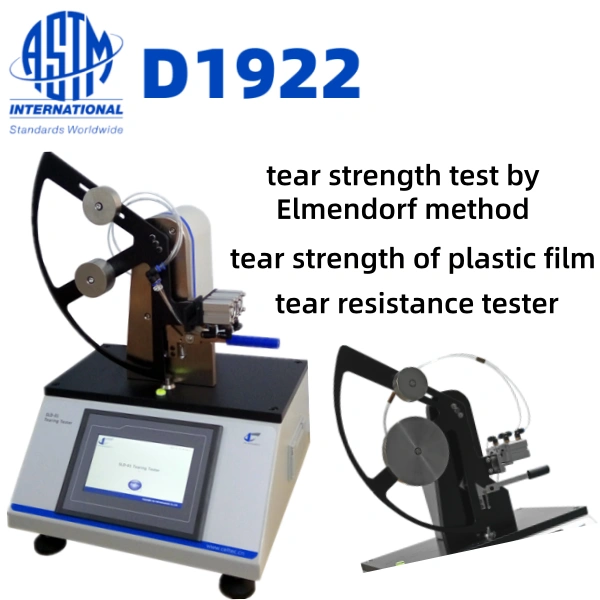
Because tear propagation often determines whether a package survives handling or fails during transportation, ASTM D1922 plays an important role in packaging quality assurance.
Why Is Tear Strength of Plastic Film Important?
The tear strength of plastic film influences how products perform throughout manufacturing, transportation, storage, and consumer use.
Examples include:
| Application | Why Tear Resistance Matters |
|---|---|
| Food Packaging | Prevent accidental package rupture during filling and transportation |
| Medical Packaging | Maintain sterile barrier integrity until opening |
| Industrial Films | Resist tearing during installation and heavy-duty handling |
| Agricultural Films | Withstand environmental stress and mechanical loading |
| Stretch & Shrink Films | Reduce damage during pallet wrapping |
| Consumer Packaging | Enable controlled opening without catastrophic tearing |
Poor tear resistance may result in:
- Product damage
- Package leakage
- Increased waste
- Customer complaints
- Higher production costs
ASTM D1922 helps manufacturers optimize materials before these failures occur.
Understanding the Elmendorf Tear Strength Test
The Elmendorf tear strength test was originally developed by Armin Elmendorf and remains one of the most trusted methods for evaluating tear propagation.
Instead of measuring the force required to create a new tear, the test measures the energy required to maintain an existing one.
The basic principle is straightforward:
- A specimen is prepared with a standardized slit.
- The specimen is clamped securely.
- A calibrated pendulum is released.
- The pendulum tears the remaining specimen.
- Energy loss is converted into tear resistance.
Because the pendulum movement is precisely controlled, the Elmendorf method provides highly repeatable results suitable for laboratory quality control.
ASTM D1922 Test Procedure
A typical ASTM D1922 test follows several standardized steps.
Sample Preparation
Rectangular specimens are cut according to the standard dimensions.
A precision cutting knife creates a slit that terminates approximately 43 mm from the opposite edge, ensuring every specimen begins with an identical tear.
Proper sample preparation is essential because inconsistent slit geometry can significantly affect results.
Specimen Clamping
The specimen is securely positioned between two clamps.
Uniform clamping pressure prevents slippage during testing and improves repeatability.
Modern tear resistance tester systems often use pneumatic clamping to reduce operator variability.
Pendulum Release
The pendulum is released automatically.
As it swings through the specimen, it propagates the tear while losing part of its potential energy.
This energy loss directly corresponds to the material’s tear resistance.
Result Calculation
The instrument automatically converts the measured energy into tear resistance values.
Most modern testers calculate:
- Individual test results
- Average tear strength
- Statistical analysis
- Standard deviation
- Multiple unit conversions where applicable
Automated calculations eliminate manual errors and improve laboratory efficiency.
What Materials Can ASTM D1922 Evaluate?
ASTM D1922 is suitable for numerous flexible materials.
Typical materials include:
- Polyethylene (PE)
- Polypropylene (PP)
- PET films
- PVC films
- Barrier films
- Laminated films
- Metallized films
- Flexible composite packaging
- Plastic sheeting
- Thin industrial films
Although primarily intended for plastic films, similar pendulum tear principles are also applied to paper, nonwoven materials, and textiles under different international standards.
Industries That Benefit from ASTM D1922
Many industries depend on reliable tear resistance data.
Common users include:
- Flexible packaging manufacturers
- Medical device packaging companies
- Pharmaceutical packaging suppliers
- Food packaging converters
- Plastic film manufacturers
- Agricultural film producers
- Industrial film processors
- Research laboratories
- Universities
- Third-party testing laboratories
For these organizations, ASTM D1922 supports both incoming material inspection and finished product validation.
Factors Affecting Tear Test Results
Several variables can influence the measured tear strength of plastic film.
These include:
- Film thickness
- Polymer molecular orientation
- Extrusion direction (MD vs. TD)
- Resin formulation
- Additives
- Temperature
- Humidity
- Specimen preparation quality
- Pendulum capacity selection
Maintaining controlled laboratory conditions is essential for obtaining meaningful and reproducible data.
ASTM D1922 vs. ISO 6383-1
Many international laboratories perform both ASTM and ISO testing.
| Feature | ASTM D1922 | ISO 6383-1 |
|---|---|---|
| Test Principle | Pendulum propagation tear | Pendulum propagation tear |
| Test Method | Elmendorf Method | Elmendorf Method |
| Primary Application | Plastic film and thin sheeting | Plastic film and sheeting |
| Result | Tear propagation resistance | Tear propagation resistance |
| International Use | North America | International markets |
Both standards use nearly identical testing concepts, making it easier for global manufacturers to compare product performance across different markets.
Selecting a Tear Resistance Tester
A reliable tear resistance tester should provide accurate pendulum movement, stable specimen clamping, and automated data processing.
Important features include:
- PLC industrial control
- Touchscreen interface
- Automatic pendulum release
- Pneumatic specimen clamping
- Multiple pendulum capacities
- Calibration verification
- Statistical analysis
- Data export capability
- Optional professional software
- Laboratory traceability
These features help ensure consistent results while reducing operator influence.
Cell Instruments SLD-01 Tear Tester
The SLD-01 Tear Resistance Tester from Cell Instruments is designed for standardized pendulum tear testing in accordance with ASTM D1922 and ISO 6383-1.
Key capabilities include:
- PLC-controlled operation with intuitive HMI touchscreen
- Pneumatic specimen clamping for improved repeatability
- Automatic pendulum release to minimize operator variability
- Multiple pendulum capacities: 200, 400, 800, 1600, 3200, and 6400 gf
- Built-in calibration weight verification
- Automatic statistical calculations
- Optional RS-232 communication and micro-printer
- Optional professional software for advanced reporting and data management
The system is suitable for quality control laboratories, R&D departments, packaging manufacturers, film producers, and independent testing laboratories requiring reliable propagation tear measurements.
Best Practices for ASTM D1922 Testing
To maximize testing accuracy:
- Condition specimens before testing.
- Use sharp cutting tools for specimen preparation.
- Select the correct pendulum capacity.
- Test both machine direction (MD) and transverse direction (TD).
- Perform sufficient replicates for statistical confidence.
- Regularly calibrate the instrument.
- Maintain consistent laboratory temperature and humidity.
Following these practices improves repeatability and ensures reliable comparison between production batches.
Conclusion
ASTM D1922 remains the industry’s preferred standard for evaluating the tear strength of plastic film using the proven Elmendorf tear strength test. Its simple yet highly repeatable Elmendorf method enables manufacturers to assess tear propagation accurately, compare material performance, optimize product design, and strengthen quality control.
Combined with a modern tear resistance tester such as the Cell Instruments SLD-01 Tear Tester, laboratories can achieve efficient testing workflows, dependable data, and improved confidence in material performance across packaging, medical, industrial, and consumer applications.