
Printed packaging, labels, cartons, and coated materials often experience repeated friction during manufacturing, transportation, storage, and consumer handling. A reliable ASTM D5264 Rub Tester helps manufacturers evaluate whether printed inks, coatings, and surface finishes can withstand abrasion without smearing, fading, transferring, or losing visual quality. By simulating real-world rubbing conditions, the instrument provides quantitative data for improving printing quality and material durability.
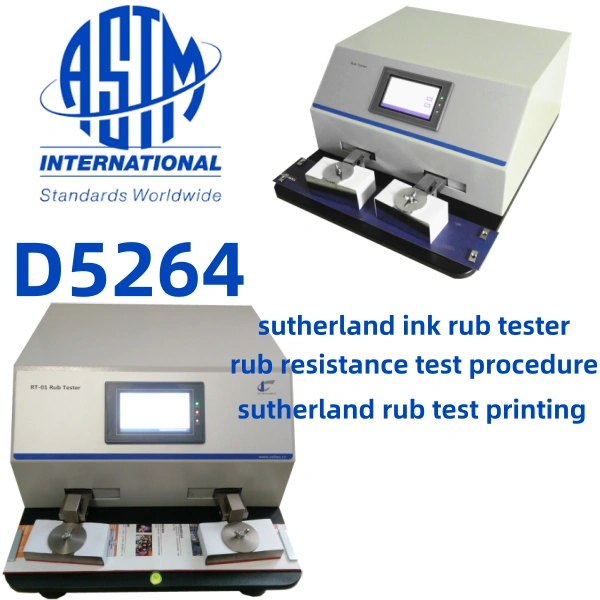
The ASTM D5264 Rub Tester is widely used as a laboratory solution for performing standardized rub resistance evaluations on printed materials. Also known as a Sutherland ink rub tester, this equipment reproduces controlled rubbing actions between a printed specimen and a receptor material to determine resistance against abrasion, ink transfer, and surface damage. It is an essential testing tool for printing companies, packaging manufacturers, paper converters, and quality control laboratories requiring consistent and repeatable test results.
What Is an ASTM D5264 Rub Tester?
An ASTM D5264 Rub Tester is a laboratory testing instrument designed to measure the abrasion resistance of printed materials, coatings, and inks under controlled rubbing conditions. The test method evaluates how well printed surfaces maintain appearance and performance after repeated mechanical friction.
Printing defects often appear after products leave the production line. Labels may become unreadable, package graphics may lose color intensity, and ink may transfer onto adjacent surfaces during stacking or transportation. A rub resistance test identifies these potential problems before products reach customers.
The RT-01 Rub Tester applies controlled pressure and reciprocating motion between two surfaces. During the test, a receptor material moves repeatedly across the printed sample. After a defined number of cycles, engineers inspect the transferred ink, surface damage, or visual changes to assess durability.
Common evaluation targets include:
- Ink abrasion resistance
- Print durability
- Coating adhesion performance
- Surface finish stability
- Smudge resistance
- Color transfer resistance
This makes the rub tester an important instrument for packaging quality assurance and printing process optimization.
Why Is Rub Resistance Testing Important?
Printed materials are exposed to many friction sources throughout their lifecycle. Even high-quality printing processes can produce insufficient durability if ink adhesion, coating formulation, or substrate compatibility is inadequate.
A professional rub resistance test procedure helps companies verify whether printed surfaces can maintain their appearance under practical handling conditions.
Key benefits include:
Prevent Printing Defects and Customer Complaints
Poor abrasion resistance can cause:
- Ink smearing during transportation
- Barcode readability issues
- Product identification problems
- Unacceptable package appearance
Testing print durability during development allows manufacturers to identify weak printing conditions and adjust ink formulations, curing parameters, or coating processes.
Improve Packaging Reliability
Packaging graphics influence product recognition and consumer confidence. For food packaging, pharmaceutical packaging, and premium consumer products, maintaining print quality is especially important.
An ASTM D5264 test helps confirm that packaging remains visually acceptable after:
- Stacking
- Shipping
- Warehouse handling
- Repeated contact
Optimize Printing Processes
Rub testing provides objective data for comparing:
- Different inks
- Different coatings
- Printing technologies
- Substrate materials
- Drying or curing conditions
Engineers can use test results to improve production efficiency while reducing material waste.
ASTM D5264 Rub Resistance Test Principle
The ASTM D5264 standard defines a method for measuring the resistance of printed materials to abrasion using a reciprocating rubbing motion.
The basic principle involves:
- Mounting the printed specimen securely on the test platform.
- Applying a specified load through a weighted receptor.
- Moving the receptor repeatedly across the printed surface.
- Evaluating ink transfer or surface damage after testing.
The RT-01 Rub Tester uses controlled arc-stroke movement to create repeatable friction conditions. The instrument simulates mechanical wear while maintaining consistent testing parameters.
Typical test factors include:
| Parameter | Description |
|---|---|
| Applied Load | 908 g (2 lb) or 1816 g (4 lb) |
| Rubbing Motion | Reciprocating arc stroke |
| Stroke Length | 57 mm ± 1 mm |
| Speed Range | 20–120 cycles per minute |
| Test Samples | 1–2 specimens |
| Evaluation | Ink transfer, smearing, abrasion damage |
By controlling these variables, laboratories can achieve reliable comparisons between different printed materials.
Sutherland Rub Test Printing Method Explained
The Sutherland rub test printing method is commonly used in the printing and packaging industries to evaluate printed surface durability. It is named after the Sutherland rub test approach, which has become a recognized technique for assessing ink resistance.
During a typical test:
1. Sample Preparation
The printed sample is cut into the required size and conditioned according to laboratory requirements.
Samples may include:
- Paperboard cartons
- Flexible packaging films
- Printed labels
- Paper sheets
- Coated surfaces
2. Sample Installation
The specimen is fixed onto the testing platform. A receptor material is attached to the rubbing head.
The receptor captures transferred ink or coating material during rubbing.
3. Load Selection
The operator selects the appropriate rubbing weight.
The RT-01 supports:
- 2 lb weight: 908 g / 8.9 N
- 4 lb weight: 1816 g / 17.8 N
Different loads allow laboratories to simulate different handling conditions.
4. Test Program Setup
The touchscreen HMI allows operators to set:
- Test speed
- Stroke count
- Test mode
- Heating temperature (optional heated configuration)
The speed range can be adjusted from 20 to 120 cycles per minute.
5. Rubbing Process
The receptor moves across the specimen using controlled arc-stroke movement.
The tester maintains:
- Consistent pressure
- Stable movement speed
- Accurate stroke distance
6. Result Evaluation
After completion, technicians examine:
- Ink transferred to receptor paper
- Color change
- Surface damage
- Coating failure
Results help determine whether the printed material meets durability requirements.
Rub Resistance Test Procedure for Laboratory Quality Control
A standardized rub resistance test procedure typically follows these steps:
| Step | Operation |
|---|---|
| 1 | Prepare and condition printed specimens |
| 2 | Install specimen and receptor material |
| 3 | Select rubbing weight according to test requirement |
| 4 | Set rubbing speed and cycle number |
| 5 | Start the rubbing test |
| 6 | Remove receptor and inspect transfer level |
| 7 | Record and compare results |
For production quality control, laboratories may establish acceptance criteria based on:
- Maximum allowable ink transfer
- Visual appearance requirements
- Customer specifications
- Internal quality standards
Testing Applications of ASTM D5264 Rub Tester
The ASTM D5264 Rub Tester supports a wide range of industries where printed appearance and surface durability are critical.
Packaging Industry
Packaging manufacturers use rub testing to verify:
- Folding carton printing durability
- Flexible packaging graphics
- Shipping box markings
- Decorative coatings
Applications include:
- Food packaging
- Beverage labels
- Pharmaceutical cartons
- Cosmetic packaging
Printing Industry
Printing houses use rub testing to optimize:
- Ink selection
- Printing parameters
- Surface treatment processes
The test helps compare different printing technologies and coating solutions.
Label Manufacturing
Labels must maintain readability throughout storage and use. Rub testing evaluates resistance to:
- Handling friction
- Moisture exposure
- Surface contact
Paper and Board Products
Paper converters evaluate:
- Coating durability
- Print quality retention
- Surface wear resistance
Materials Suitable for Rub Resistance Testing
The RT-01 Rub Tester can evaluate many printed and coated materials, including:
- Paper
- Cardboard
- Corrugated board
- Coated paper
- Plastic films
- Flexible packaging materials
- Labels
- Laminated materials
- Printed polymer substrates
Different material combinations can be tested to understand the relationship between substrate properties and ink durability.
Advanced Testing Modes for Different Applications
Beyond standard dry rubbing evaluation, customized configurations allow additional testing applications.
Dry Rub Testing
Dry rub testing evaluates standard abrasion resistance under normal handling conditions.
It is commonly used for:
- Printed cartons
- Labels
- Paper products
Wet Rub Testing
Wet rubbing evaluates performance when moisture is present.
This helps assess:
- Ink bleeding
- Color migration
- Surface durability in humid environments
Heated Rub Testing
A heated configuration can evaluate coating and ink stability under elevated temperatures.
Applications include:
- Heat-sensitive packaging
- Thermal processing environments
- Specialized coating evaluations
Wet Smear and Transfer Testing
These methods help identify whether printed surfaces experience:
- Ink migration
- Smearing
- Transfer problems
ASTM D5264 Rub Tester Features
The RT-01 Rub Tester is designed for laboratories requiring accurate and efficient abrasion testing.
Key features include:
- Touchscreen operation for easy parameter setup
- Adjustable rubbing speed from 20–120 cpm
- Two standard testing weights
- Precise arc-stroke movement
- Real-time monitoring of stroke count and speed
- Support for customized testing requirements
Technical specifications:
| Specification | Value |
|---|---|
| Weight Options | 908 g (2 lb), 1816 g (4 lb) |
| Speed | 20–120 cpm adjustable |
| Number of Specimens | 1–2 |
| Rotation Radius | 185 mm |
| Arc Length | 57 mm ± 1 mm |
| Dimensions | 390 × 480 × 220 mm |
| Power Supply | 110–220 V, 50/60 Hz |
Related Standards for Rub Testing
The ASTM D5264 Rub Tester supports compliance with several recognized testing methods, including:
| Standard | Description |
|---|---|
| ASTM D5264 | Standard practice for abrasion resistance of printed materials |
| TAPPI T830 | Ink rub testing method for printed materials |
| ASTM F1571 | Related packaging and printing evaluation method |
| ASTM F2497 | Related print performance testing |
These standards provide guidance for evaluating print durability across different industries.
How to Select the Right Rub Tester?
When selecting a rub tester, laboratories should consider:
Testing Requirements
Determine whether testing focuses on:
- Dry abrasion
- Wet abrasion
- Heat resistance
- Ink transfer
Material Type
Consider the substrate being tested, such as:
- Paper
- Film
- Label stock
- Coated packaging
Testing Frequency
High-volume quality control laboratories may require:
- Easy operation
- Automated recording
- Repeatable test conditions
Customization Needs
Some applications require customized fixtures, heating functions, or special test configurations.
A professional instrument supplier can provide solutions based on specific material and production requirements.
Conclusion
The ASTM D5264 Rub Tester provides an effective method for evaluating the durability of printed materials, inks, and coatings. Through controlled rubbing conditions, manufacturers can identify abrasion weaknesses, improve printing processes, and ensure packaging maintains its quality throughout the product lifecycle.
As a reliable Sutherland ink rub tester, the RT-01 supports dry rub, wet rub, heated rub, and customized testing applications for packaging, printing, and material quality laboratories. By implementing a consistent rub resistance test procedure, companies can improve quality control, reduce production risks, and deliver more durable printed products.