ASTM F1921

Hot Tack Test Method

ASTM F1921 defines a standardized method to measure hot tack strength of thermoplastic seals immediately after formation, providing critical insight into seal integrity during real packaging operations. By controlling parameters such as temperature, pressure, dwell time, and delay time, the test generates data on seal performance under thermal stress. The resulting hot tack curve helps identify optimal sealing conditions and material suitability. This method is essential for ensuring packaging reliability, reducing failure risks, and optimizing form-fill-seal processes across multiple industries.

ASTM F1921 and Hot Tack Test Method

ASTM F1921 defines a laboratory method for measuring the strength of heat seals immediately after formation, before the material cools to ambient temperature. This property—known as hot tack strength—is critical in high-speed packaging environments, especially form-fill-seal (FFS) processes.

У "The hot tack test method simulates actual sealing conditions by applying controlled heat and pressure to thermoplastic films.

Unlike conventional seal strength tests performed at room temperature, ASTM F1921 and hot tack test method evaluates real-time seal integrity under thermal stress, making it highly relevant for production stability and packaging reliability.

Hot Tack Test Process

ASTM F1921 determines the strength of a heat seal immediately after it is formed. The test cycle includes sealing, opening of jaws, withdrawal, delay/cooling, and separation of grips to measure the force.

Hot Tack Testing Process 1 Seal

1. Seal

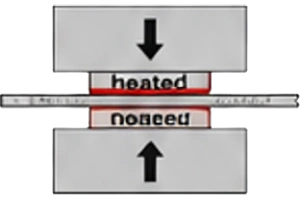
Two strips are sealed under defined temperature, pressure and dwell time.

Hot Tack Testing Process 2 Open Jaws

2. Open Jaws

The jaws open and the sealed area is released.

Hot Tack Testing Process 3 Withdraw

3. Withdraw

The specimen is automatically withdrawn from between the jaws.

Hot Tack Testing Process 4 Delay Cooling

4. Delay / Cooling

A preset delay (cooling time) begins after jaw opening.

Hot Tack Testing Process 5 Separate & Measure

5. Separate & Measure

Grips separate at a constant speed and the force required to open the seal is measured until failure.

Key Variables in ASTM F1921 Testing

  • Sealing temperature: Typically varied to generate a hot tack curve
  • Dwell time:
    • ≤25 µm films: ~0.5 s
    • 25–64 µm films: ~1.0 s
    • 64 µm films: ~2.5 s
  • Sealing pressure: 15–30 N/cm²
  • Cooling time / delay time: Defines measurement timing
  • Separation speed: Typically 200 mm/min (Method A)

These parameters directly influence the resulting hot seal strength of flexible packaging materials.

Hot Tack Tester: Essential Equipment for ASTM F1921

A hot tack tester is specifically designed to replicate the sealing and immediate peel process defined in ASTM F1921. Advanced systems—such as those developed by Cell Instruments Co., Ltd.—offer:

  • PLC-based control systems for repeatability
  • PID temperature regulation (±0.2°C accuracy)
  • Automated test cycles eliminating operator influence
  • Adjustable test speeds and pressures
  • High-resolution force measurement

Recommended Solution

The Cell Instruments HTT series supports:

  • Method A (Fixed Delay) і Method B (Variable Delay)
  • Multiple test modes: hot tack, peel, tensile, heat seal
  • High-speed testing up to 12000 mm/min (HTT-02)

This flexibility enables precise characterization of different materials and sealing behaviors.

ASTM F1921 Hot Tack Tester

Hot Seal Strength of Flexible Packaging

У "The hot seal strength of flexible packaging determines whether a package can withstand stress immediately after sealing. Weak hot tack can lead to:

  • Seal opening during filling
  • Product contamination or leakage
  • Reduced packaging efficiency
  • Increased waste and downtime

ASTM F1921 helps manufacturers:

  • Rank material performance
  • Optimize sealing parameters
  • Ensure process robustness in FFS operations

ASTM F1921 Test Methods
—Method A vs Method B

ASTM F1921 specifies two distinct approaches:

Method A – Fixed Delay

  • Measures seal strength at specific cooling times
  • Produces a hot tack strength vs time curve
  • Suitable for detailed cooling behavior analysis

Method B – Variable Delay

  • Measures maximum force after a selected delay
  • Faster and simpler for routine QC testing
  • Ideal for production environments

Failure Modes in Hot Tack Testing

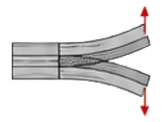
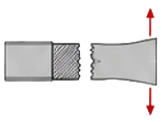
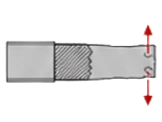
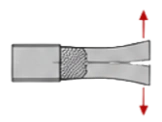
To correctly interpret ASTM F1921 results, understanding seal separation modes is essential. Different failure behaviors indicate different material or process issues.

Failure Modes in Hot Tack Testing 1

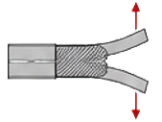
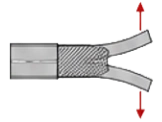
Adhesive Peel

Separation occurs at the interface between the two surfaces.
Indicates: Poor interfacial bonding or insufficient heat/pressure.

Failure Modes in Hot Tack Testing 2

Cohesive Peel

Failure occurs within one of the polymer layers.
Indicates: Strong interfacial bonding; material itself fails.

Failure Modes in Hot Tack Testing 3

Delamination

Separation between layers of a multi-layer structure.
Indicates: Weak bonding between layers in laminated materials.

Failure Modes in Hot Tack Testing 4

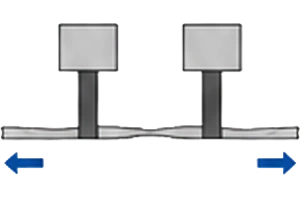
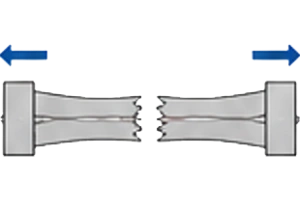
Material Break

Film breaks away from the seal area
Indicates: Seal is stronger than the substrate.

Failure Modes in Hot Tack Testing 5

Remote Break

Break occurs at a location remote from the seal.
Indicates: Seal is much stronger than the material.

Failure Modes in Hot Tack Testing 6

Material Elongation

Unsealed material stretches significantly before breaking.
Indicates: High ductility and flexibility of film.

Failure Modes in Hot Tack Testing 7

Peel with Elongation

Peeling accompanied by significant elongation of the unsealed material.
Indicates: Combination of adhesive failure and material ductility.

Building a Hot Tack Curve for Process Optimization

A hot tack curve plots seal strength versus temperature. It helps identify:

  • Seal initiation temperature (SIT)
  • Optimal sealing window
  • Maximum hot tack strength

This data enables engineers to fine-tune sealing parameters for consistent packaging performance.

FAQs about ASTM F1921

  1. What is the main purpose of ASTM F1921?
    It evaluates the hot tack strength of thermoplastic seals immediately after sealing, ensuring packaging reliability during production.
  2. How is ASTM F1921 different from ASTM F88?
    ASTM F1921 measures hot seal strength, while ASTM F88 measures cold seal strength after cooling.
  3. Which industries rely on hot tack testing?
    Food, pharmaceutical, medical device, and flexible packaging industries rely heavily on this test.
  4. What is the difference between Method A and Method B?
    Method A measures strength over time; Method B records the maximum force after a delay.
  5. Why is hot tack important in FFS processes?
    Because seals experience stress before cooling, insufficient hot tack can cause seal failure during packaging.
Рекомендуємо
Контакти
Нещодавно

Забирай.

ASTM F1921

Рішення

Evaluate your packaging performance with ASTM F1921 hot tack testing. By measuring seal strength immediately after sealing, this method helps identify optimal process parameters and material suitability. With advanced hot tack testers, you can generate accurate hot tack curves, analyze failure modes, and improve seal reliability in high-speed production. Enhance quality control, reduce waste, and ensure consistent packaging integrity with precise and repeatable testing solutions.

Стандартний

ASTM F1921

Галузі промисловості

Flexible packaging manufacturing
Food and beverage packaging
Pharmaceutical packaging
Medical device packaging
Adhesives and coatings
Plastics and polymer processing
Quality inspection laboratories

Матеріал

Поліетилен (PE)
Поліпропілен (PP)
Multilayer laminated films
Coextruded films
Barrier films (EVOH, PVDC)
Heat-sealable coatings
Flexible composite materials