
ASTM D1424 is one of the most widely recognized standards for evaluating the tear resistance of woven fabrics using the Elmendorf pendulum principle. The standard provides a reliable and repeatable fabric tear strength test method for determining the force required to propagate an existing tear in textile materials. Manufacturers, laboratories, apparel brands, and quality control professionals rely on ASTM D1424 data to evaluate product durability, compare material performance, optimize fabric construction, and ensure consistent production quality.
As textile products become lighter, stronger, and more specialized, understanding the tear strength of textile materials has become increasingly important. Whether producing workwear, outdoor fabrics, automotive textiles, medical textiles, or industrial fabrics, accurate tear testing helps manufacturers reduce failures while maintaining material efficiency.
What Is ASTM D1424?
ASTM D1424 is the standard test method for determining the tearing strength of fabrics by means of a falling-pendulum (Elmendorf-type) apparatus. Instead of measuring the force required to initiate a tear, the test evaluates the energy required to continue tearing from a pre-cut slit.
The test is based on a simple but highly repeatable mechanical principle:
- Mẫu được chuẩn bị với một khe hở theo tiêu chuẩn.
- The specimen is clamped between two jaws.
- A pendulum is released.
- As the pendulum swings, it propagates the tear.
- The energy lost during tearing is converted into tear resistance.
This Elmendorf tear test of fabric provides an efficient way to compare materials that may experience tearing during manufacturing, transportation, or end use.
Why Is Fabric Tear Resistance Important?
Tensile strength and tear strength measure different material properties.
A fabric may exhibit high tensile strength but still tear easily once a small cut, puncture, or defect develops. Tear resistance evaluates a material’s ability to prevent damage from spreading.
Key benefits include:
- Evaluating product durability
- Comparing fabric constructions
- Optimizing yarn selection
- Improving weave or knit design
- Supporting material qualification
- Reducing customer complaints
- Improving production consistency
Industries increasingly specify ASTM D1424 because tear resistance directly relates to real-world performance.
Testing Principle of ASTM D1424
Cái fabric tear strength test method uses gravitational energy generated by a calibrated pendulum.
The testing sequence includes:
- Preparing a standardized specimen.
- Introducing a precise pre-cut slit.
- Securing the specimen with calibrated clamps.
- Releasing the pendulum.
- Measuring the energy consumed while propagating the tear.
The greater the energy absorbed during tearing, the higher the tear resistance.
Unlike tensile testing, ASTM D1424 measures sự lan truyền vết nứt, making it particularly valuable for assessing damage tolerance.
Typical ASTM D1424 Test Procedure
Although laboratories should always follow the latest ASTM standard, the general workflow includes the following steps.
| Test Step | Mô tả |
|---|---|
| Specimen conditioning | Condition specimens under standard laboratory atmosphere. |
| Specimen preparation | Cut specimens according to ASTM D1424 dimensions. |
| Initial slit | Produce a standardized slit before testing. |
| Specimen clamping | Secure the specimen without introducing distortion. |
| Pendulum release | Release the calibrated pendulum automatically or manually. |
| Tear propagation | Pendulum tears the specimen over the specified distance. |
| Data recording | Instrument calculates tear force from pendulum energy loss. |
| Phân tích thống kê | Average multiple specimens for final reporting. |
Multiple specimens should be tested in both warp and weft directions because woven fabrics often exhibit directional differences.
Các vật liệu phù hợp
ASTM D1424 is primarily designed for woven textile materials but is also applicable to many industrial sheet materials.
Các vật liệu điển hình bao gồm:
- Cotton fabrics
- Polyester fabrics
- Nylon fabrics
- Denim
- Canvas
- Upholstery fabrics
- Technical textiles
- Protective clothing fabrics
- Industrial woven fabrics
- Medical textile substrates
- Nonwoven fabrics (where appropriate)
- Laminated textile materials
Proper material selection for the testing method should always follow the scope defined in ASTM D1424.
Industries That Use ASTM D1424
Many industries depend on reliable tear strength of textile data.
Các ứng dụng phổ biến bao gồm:
- Apparel manufacturing
- Outdoor equipment
- Military textiles
- Automotive interiors
- Medical textiles
- Geotextiles
- Protective clothing
- Industrial filtration
- Home furnishings
- Furniture fabrics
- Aerospace textiles
- Sports equipment
For these industries, tear resistance often represents a critical quality indicator alongside tensile strength, abrasion resistance, and seam performance.
Understanding ASTM D1424 Test Results
Results are generally reported as tearing force or tearing resistance derived from pendulum energy.
Higher values generally indicate:
- Better resistance to tear propagation
- Improved durability
- Longer product service life
- Better resistance to accidental damage
However, interpretation should consider:
- Fabric weight
- Yarn count
- Fiber type
- Weave construction
- Fabric finish
- Moisture condition
- Testing direction (warp/weft)
Comparisons should only be made between specimens tested under identical conditions.
Factors Affecting Tear Strength
Several variables influence ASTM D1424 results.
Fiber Type
Different fibers exhibit different tear behaviors.
Một số ví dụ bao gồm:
- Cotton
- Polyester
- Nylon
- Aramid
- UHMWPE
- Blended fibers
Fabric Construction
Construction characteristics significantly affect tear resistance:
- Plain weave
- Twill weave
- Satin weave
- Ripstop structures
- Knit constructions
Finishing Treatments
Chemical and mechanical treatments may alter tear performance:
- Resin finishing
- Water repellents
- Flame-retardant coatings
- Laminations
- Calendaring
Environmental Conditions
Laboratory conditioning is essential because humidity and temperature can influence textile performance.
ASTM D1424 Compared with Other Tear Test Standards
Different tear methods evaluate different aspects of material performance.
| Tiêu chuẩn | Phương pháp thử nghiệm | Typical Materials | Main Feature |
|---|---|---|---|
| ASTM D1424 | Con lắc Elmendorf | Vải dệt | Measures tear propagation energy |
| ASTM D2261 | Tongue tear | Fabrics | Constant-rate tensile machine |
| ASTM D5587 | Trapezoid tear | Fabrics | Progressive tear under tensile loading |
| ASTM D1922 | Vết rách Elmendorf | Màng nhựa | Pendulum tear for thin plastic films |
| ISO 13937-1 | Elmendorf | Vải dệt | International equivalent method |
Selecting the appropriate method depends on product design, customer specifications, and regulatory requirements.
Equipment for ASTM D1424 Testing
Reliable testing requires a precision Elmendorf tear tester with stable mechanical performance and accurate calibration.
Các tính năng quan trọng bao gồm:
- High-accuracy pendulum system
- Chức năng giải phóng con lắc tự động
- Precision specimen clamps
- Industrial PLC control
- Giao diện màn hình cảm ứng
- Tính toán thống kê tự động
- Xác minh hiệu chuẩn
- Khả năng xuất dữ liệu
- Optional printer
- Các mức công suất của con lắc đa năng
Consistent equipment performance minimizes operator variability and improves laboratory repeatability.
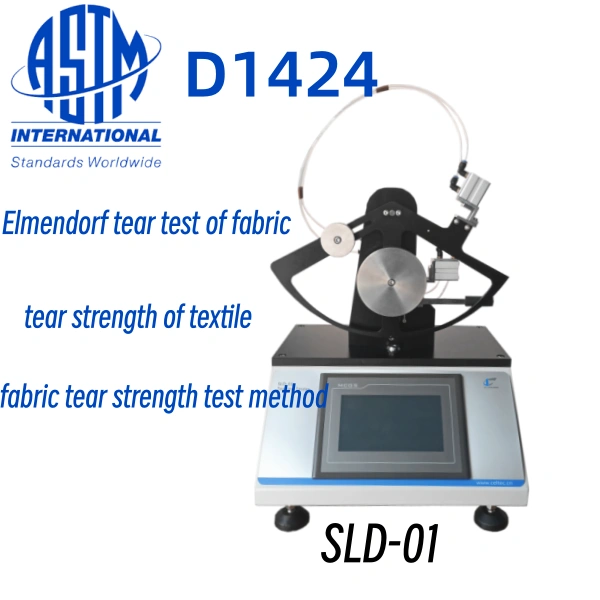
Cell Instruments SLD-01 Tear Tester Solution
Đối với các phòng thí nghiệm thực hiện ASTM D1424 testing, the SLD-01 Elmendorf Tear Tester from Cell Instruments provides a professional solution for pendulum-based tear resistance measurement.
Các tính năng chính bao gồm:
- Điều khiển PLC với màn hình cảm ứng HMI for simple operation
- Automatic pneumatic specimen clamping for repeatable positioning
- Chức năng giải phóng con lắc tự động to reduce operator influence
- Các mức công suất của con lắc đa năng: 200, 400, 800, 1600, 3200 và 6400 gf
- Built-in calibration verification
- Tính toán thống kê tự động
- Tùy chọn giao tiếp RS-232 và máy in siêu nhỏ
- Phần mềm chuyên dụng (tùy chọn) for data analysis and reporting
These capabilities support efficient quality control, research, product development, and routine laboratory testing across textile and industrial material applications.
Benefits of ASTM D1424 in Quality Control
Routine implementation of ASTM D1424 offers several advantages:
- Detects weak fabric constructions before production
- Supports supplier qualification
- Improves product consistency
- Assists R&D in material optimization
- Reduces warranty claims
- Verifies compliance with customer specifications
- Supports continuous process improvement
Because tear resistance closely reflects actual product durability, ASTM D1424 remains an essential quality control tool throughout the textile industry.
Kết luận
ASTM D1424 remains one of the most trusted standards for evaluating the tear resistance of woven fabrics using the Elmendorf pendulum method. The standardized Elmendorf tear test of fabric provides reliable, repeatable data for comparing materials, optimizing product design, and maintaining manufacturing quality. By understanding the fabric tear strength test method and correctly interpreting the tear strength of textile results, manufacturers can improve product durability, reduce failures, and make informed material selection decisions. Combined with modern testing equipment such as the Cell Instruments SLD-01 Tear Tester, ASTM D1424 supports accurate laboratory testing and robust quality assurance across a wide range of textile applications.