
Plastic films used in packaging, industrial protection, and consumer products must withstand unexpected impacts during transportation, processing, and daily use. JIS K 7124-1 defines a standardized method for evaluating the impact resistance of plastic films and sheeting using the free-falling dart method. The FDT-01 Falling Dart Impact Tester provides an automated solution for performing this test, helping manufacturers and laboratories accurately measure film toughness, optimize material structures, and ensure product reliability.
Impact resistance is a critical mechanical property for flexible packaging materials. A film may have excellent tensile strength or thickness performance but still fail when exposed to sudden impact forces. Through a standardized zkouška nárazem šipkou u plastové fólie, engineers can quantify the energy required to cause failure and compare different materials, formulations, and production processes.
The FDT-01 Falling Dart Impact Tester is designed to meet the requirements of JIS K 7124-1, ASTM D1709, ISO 7765-1, and other international test methods. With automated dart release, pneumatic clamping, intelligent calculation, and reliable data output, the instrument supports quality control laboratories, packaging manufacturers, and material research departments in achieving consistent and traceable impact testing results.
What Is JIS K 7124-1 Falling Dart Impact Testing?
JIS K 7124-1 is a test standard used to determine the impact resistance of plastic films and sheeting by the free-falling dart method. The method evaluates how much impact energy a film can absorb before it breaks.
During the test, a weighted dart is released from a specified height and falls freely onto a clamped film specimen. By adjusting the dart weight and recording whether each specimen fails or passes, the tester determines the impact strength of the material.
The test result is commonly expressed as:
- Dart weight causing 50% failure (g)
- Impact energy at failure (Joule)
This measurement provides a direct indication of film toughness and resistance to sudden impact forces.
Unlike slow mechanical tests such as tensile testing, the falling dart method simulates rapid impact events that occur in real applications, including:
- Package drops during transportation
- Sharp object contact
- Automated packaging handling
- Product loading impacts
- Consumer handling conditions
For packaging engineers, the falling dart impact test provides essential information for selecting suitable film structures and preventing unexpected package failures.
Why Is Plastic Film Impact Resistance Important?
Plastic films often experience dynamic forces that cannot be predicted through static strength measurements alone. A packaging film may crack, puncture, or split when exposed to sudden impact even if it performs well in other mechanical tests.
Reliable impact testing helps manufacturers achieve several important goals.
Protecting Product Safety
Packaging failure during logistics can lead to:
- Kontaminace výrobku
- Leakage
- Loss of shelf life
- Stížnosti zákazníků
- Nárůst množství odpadu
Impact resistance testing allows engineers to verify whether packaging materials can withstand real transportation conditions.
Optimizing Material Costs
Material thickness directly affects packaging cost, storage space, and environmental impact.
Použitím zkušební zařízení s padajícím šipkou, manufacturers can compare:
- Different resin grades
- Film thicknesses
- Multi-layer structures
- Přísady
- Manufacturing processes
This allows companies to reduce unnecessary material usage while maintaining required durability.
Improving Quality Control
Production variations may affect film impact performance. Regular impact testing helps detect:
- Extrusion process changes
- Raw material inconsistencies
- Coating defects
- Lamination problems
Laboratories can establish acceptance criteria and monitor supplier quality using standardized impact resistance data.
How Does the Dart Impact Test for Plastic Film Work?
Na stránkách zkouška nárazem šipkou u plastové fólie uses a controlled free-falling dart to apply impact force to a film specimen.
The basic testing principle is:
Impact energy = Dart mass × Gravity × Falling height
When the dart strikes the film, the specimen either survives the impact or fails. By testing multiple samples at different dart weights, the instrument determines the weight level where approximately 50% of samples fail.
Postup testování
The typical procedure using the FDT-01 Falling Dart Impact Tester includes the following steps:
1. Mount the Specimen
The plastic film sample is positioned between pneumatic clamps.
The clamping system ensures:
- Stable specimen fixation
- Uniform tension
- Omezený vliv obsluhy
- Opakovatelné zkušební podmínky
The recommended specimen size is larger than 150 mm × 150 mm.
2. Select Test Method
The operator selects the appropriate test method:
Metoda A
- Used for materials with lower impact resistance
- Dart diameter: 38 ± 1 mm
- Test range: 50–2000 g
Metoda B
- Used for stronger films requiring higher impact energy
- Dart diameter: 50 ± 1 mm
- Test range: 300–2000 g
3. Release the Dart
The electromagnetic suspension system releases the dart without mechanical friction.
This ensures:
Zlepšená opakovatelnost
4. Record Failure Results
Accurate free fall
Stable impact energy
After each impact, the system records:
- Pass result
- Failure result
The tester continues testing according to the selected staircase method.
5. Calculate Impact Resistance
The instrument automatically calculates:
- Critical dart weight
- Energie nárazu
- Statistical failure point
FDT-01 Falling Dart Impact Tester Technical Features
The FDT-01 is engineered for laboratories requiring accurate, efficient, and repeatable impact testing.
Intelligent Control System
The instrument integrates:
- PLC industrial control system
- 7palcový dotykový displej HMI
- Automatic calculation functions
Operators can easily configure test parameters and obtain results without complicated manual calculations.
Pneumatické upínání vzorků
The pneumatic clamping system securely holds the film specimen while minimizing deformation.
Mezi výhody patří:
- Faster sample installation
- Better operator consistency
- Improved testing reliability
Automated Dart Release System
The electromagnetic dart release mechanism provides:
- Friction-free operation
- Consistent release timing
- Improved test repeatability
This eliminates errors caused by manual release methods.
Safety and Data Management
Additional functions include:
- Foot switch operation
- Test button control
- Osvětlení pro pozorování
- Volitelná mikrotiskárna
- Optional software data export
These features improve laboratory efficiency and support traceable quality management.
Flexible Testing Methods
The FDT-01 supports:
| Funkce | Metoda A | Metoda B |
|---|---|---|
| Žádost | Standard film testing | Higher strength films |
| Průměr šipky | 38 ± 1 mm | 50 ± 1 mm |
| Testovací rozsah | 50–2000 g | 300–2000 g |
| Výška nárazu | 660 mm | 1500 mm |
Technical Specifications of FDT-01 Falling Dart Impact Tester
| Parametr | Specifikace |
|---|---|
| Zkušební metoda | Method A or Method B (optional) |
| Testovací rozsah | Method A: 50–2000 g; Method B: 300–2000 g |
| Průměr šipky | Method A: 38 ± 1 mm; Method B: 50 ± 1 mm |
| Výška nárazu | 660 mm / 1500 mm |
| Přesnost | 0.1 g / 0.1 J |
| Clamp Type | Pneumatic clamp |
| Dodávky plynu | 0.6 MPa, Φ8 mm PU tubing |
| Velikost vzorku | >150 mm × 150 mm |
| Napájení | 110–220 V střídavého proudu, 50 Hz |
| Dimension | Method A: 500 × 450 × 1200 mm; Method B: 500 × 450 × 2200 mm |
Materials Suitable for Falling Dart Impact Testing
The FDT-01 falling dart impact tester is suitable for a wide range of flexible materials with thickness up to 1 mm.
Mezi typické materiály patří:
| Material Category | Examples |
|---|---|
| Plastové fólie | PE, PP, PET, PVC films |
| Barrier Films | Aluminum laminated films, multilayer films |
| Packaging Films | Stretch films, food packaging films |
| Coated Materials | Coated paper and laminated sheets |
| Kompozitní materiály | Flexible packaging structures |
Material developers can use impact testing data to evaluate new formulations, improve multilayer structures, and verify product performance.
Related Impact Testing Standards
The FDT-01 Falling Dart Impact Tester complies with major international standards.
| Standardní | Popis |
|---|---|
| JIS K 7124-1 | Plastics film and sheeting — Determination of impact resistance by the free-falling dart method — Part 1: Staircase methods |
| ASTM D1709 | Standardní zkušební metody pro stanovení odolnosti plastových fólií proti nárazu metodou volně padajícího šipky |
| ISO 7765-1 | Plastics film and sheeting — Determination of impact resistance by the free-falling dart method — Part 1: Staircase methods |
| GB/T 9639.1 | Plastics film and sheeting — Determination of impact resistance by the free-falling dart method |
These standards provide internationally recognized procedures for evaluating film impact performance.
Comparison with Other Impact Testers
Different materials and applications require different impact testing methods.
| Tester | Hlavní aplikace |
|---|---|
| FDT-01 Tester nárazů padajícími šipkami | Plastic film and flexible packaging impact resistance |
| FBT-01 Zkušební zařízení pro zkoušku nárazem padající koule | Falling ball impact evaluation |
| PIT-01 Zkušební zařízení pro nárazové zkoušky s kyvadlem | Pendulum impact resistance testing |
| PHS-01 IEC Electronic Products Impact Tester | Electronic product impact testing |
| Zkušební stroj pro rázovou houževnatost podle Charpyho a Izoda | Rigid plastics and engineering materials |
Selecting the correct testing method ensures that test results accurately represent real-world application conditions.
Choosing the Right Falling Dart Impact Tester
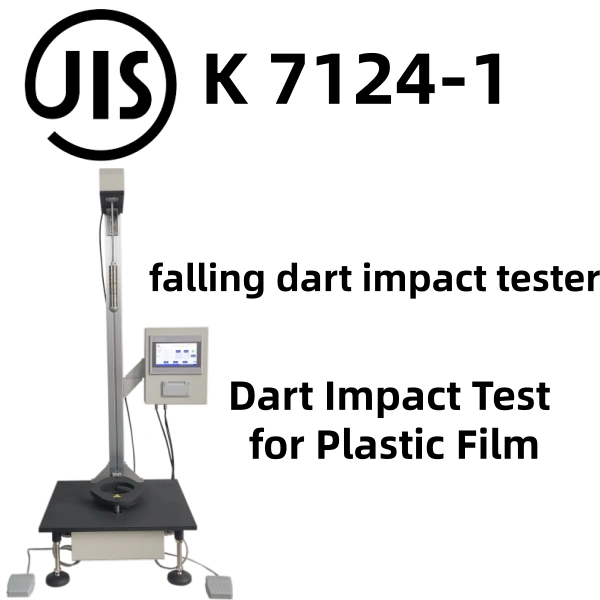
When selecting impact testing equipment, laboratories should consider:
- Applicable testing standards
- Material thickness range
- Required impact energy range
- Test frequency
- Data management requirements
- Automation requirements
The FDT-01 provides a reliable solution for organizations requiring standardized impact resistance testing according to JIS K 7124-1 and other international standards.
With automated operation, accurate measurement, and flexible testing configurations, it helps manufacturers improve packaging reliability, optimize materials, and maintain consistent product quality.