
Impact resistance is a critical performance property for packaging films, plastic sheets, foils, and composite materials that experience sudden mechanical shocks during transportation, handling, and end-use applications. The ASTM D3420 Pendulum Impact Tester provides a reliable method to evaluate the impact strength of flexible and thin materials by measuring the energy required to puncture or rupture a specimen under controlled impact conditions.
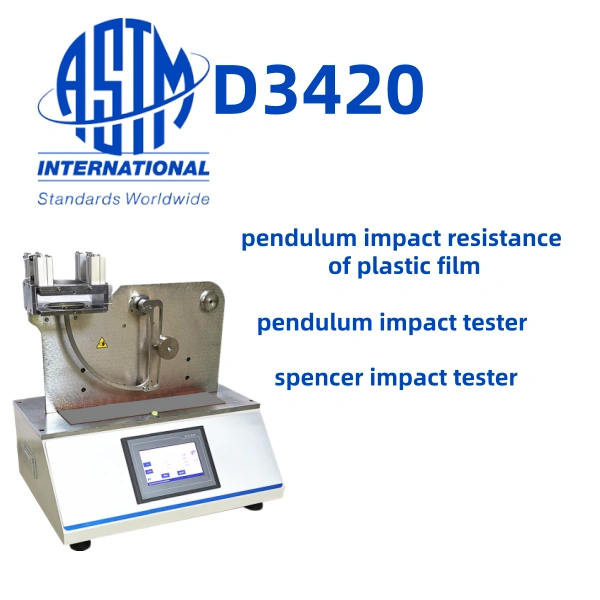
For manufacturers and laboratories involved in packaging development, quality control, and material research, understanding pendulum impact resistance of plastic film helps ensure products can withstand real-world impact events without unexpected failure. The PIT-01 Pendulum Impact Tester from Cell Instruments is designed to perform accurate impact resistance testing according to ASTM D3420, offering stable operation, automated control, and repeatable measurement results for professional material evaluation.
What Is ASTM D3420 Impact Testing?
ASTM D3420 is a standard test method used to determine the impact resistance of plastic films and thin sheeting by applying a controlled pendulum impact force to the center of a specimen. The test measures the amount of energy absorbed by the material before failure occurs.
Unlike static mechanical tests such as tensile strength testing, impact testing evaluates how a material behaves when exposed to a sudden force. Many packaging materials may show excellent tensile strength but still fail under rapid impact conditions because they cannot absorb energy quickly enough.
The ASTM D3420 method helps engineers understand:
- Material toughness under sudden loading
- Resistance to puncture and rupture
- Energy absorption capability
- Differences between film structures or formulations
- Effects of thickness, additives, and manufacturing processes
This information supports material selection, packaging optimization, and production quality control.
Why Pendulum Impact Resistance of Plastic Film Matters
Plastic films and flexible packaging materials frequently experience unexpected impacts throughout their lifecycle. During manufacturing, filling, transportation, and consumer use, materials may encounter drops, sharp edges, vibration, or compression forces that can create impact stress.
Poor impact resistance may lead to:
- Film tearing during packaging operations
- Package leakage caused by puncture damage
- Product contamination risks
- Increased material waste
- Customer complaints and product returns
Testing pendulum impact resistance of plastic film allows manufacturers to predict material performance before products enter the market.
For example, food packaging films must maintain integrity when transported through complex supply chains. Medical packaging materials require reliable resistance against accidental damage to protect sterile contents. Industrial films used in protective packaging must withstand mechanical abuse during handling.
By measuring impact energy accurately, ASTM D3420 testing provides engineers with quantitative data rather than relying on visual inspection or field failures.
Principle of Pendulum Impact Testing
The working principle of the ASTM D3420 Pendulum Impact Tester is based on energy absorption measurement.
During the test:
- A specimen is securely fixed between pneumatic clamps.
- A pendulum with a specified impact head is released automatically.
- The pendulum strikes the center area of the specimen.
- The instrument measures the energy lost by the pendulum during impact.
- The absorbed energy represents the impact resistance of the material.
The higher the absorbed impact energy, the stronger the material’s resistance to sudden impact failure.
The energy calculation depends on factors including:
- Pendulum mass
- Release angle
- Impact head geometry
- Material deformation behavior
- Energy loss after specimen rupture
The precise angle measurement system of the tester ensures accurate calculation of impact energy values.
ASTM D3420 Pendulum Impact Tester Test Method
A typical ASTM D3420 test procedure includes several controlled steps to ensure reliable results.
Preparazione del campione
Test specimens are usually prepared according to the requirements of the material and application.
Common specimen characteristics include:
- Flat film or sheet samples
- Uniform thickness
- Controlled environmental conditioning
- Proper dimensions for fixture installation
Conditioning is important because temperature and humidity can influence the flexibility and toughness of polymer materials.
Specimen Installation
The specimen is positioned between circular clamps. The ASTM D3420 Pendulum Impact Tester uses pneumatic clamping technology to provide consistent holding pressure.
Reliable clamping prevents:
- Specimen slipping
- Uneven stress distribution
- Testing errors caused by operator variation
Pendulum Release and Impact
After the specimen is installed, the pendulum is automatically released.
The impact head contacts the center of the specimen and transfers kinetic energy into the material. If the specimen fails, the absorbed energy is calculated from the difference between the initial and final pendulum movement.
Result Analysis
The test result represents the impact energy required to cause failure.
Laboratories typically analyze:
- Average impact energy
- Maximum and minimum values
- Material variation between samples
- Comparison between different film structures
Multiple tests are normally performed to improve statistical reliability.
Key Features of ASTM D3420 Pendulum Impact Tester
The PIT-01 Pendulum Impact Tester integrates advanced control technology with practical laboratory operation requirements.
PLC Control and HMI Touch Screen
The system uses an industrial-grade PLC controller combined with an intuitive HMI touchscreen interface.
I vantaggi includono:
- Funzionamento stabile
- Impostazione semplice dei parametri
- Easy test management
- Reduced operator errors
The user-friendly interface makes the instrument suitable for both research laboratories and production quality control environments.
Pneumatic Specimen Clamping System
Consistent specimen fixation is essential for impact testing accuracy.
The pneumatic clamping system provides:
- Uniform holding force
- Fast specimen installation
- Maggiore ripetibilità
- Reduced manual operation differences
This feature is particularly valuable when laboratories perform large numbers of quality control tests.
Automatic Pendulum Release
The automatic pendulum release mechanism improves testing consistency by eliminating manual release variation.
Tra i vantaggi figurano:
- Better repeatability
- Higher testing efficiency
- Improved operator safety
- More reliable comparison between materials
Automatic Data Statistics
The instrument can automatically collect and analyze test results from multiple measurements.
This helps laboratories:
- Identify material variation
- Generate test reports efficiently
- Support quality documentation
- Improve production decision-making
Precise Angle Measurement
Accurate angle measurement is essential because impact energy calculation depends directly on pendulum movement.
The ASTM D3420 Pendulum Impact Tester provides precise measurement capability to ensure reliable impact energy results.
Built-In Microprinter and Data Output
The integrated microprinter allows immediate printing of test results.
Optional RS232 communication and software enable:
- Computer data management
- Test result storage
- Further statistical analysis
- Laboratory information system integration
Applications of Pendulum Impact Testing
The ASTM D3420 Pendulum Impact Tester is widely used across industries where thin materials require reliable impact resistance evaluation.
Flexible Packaging Industry
Flexible packaging manufacturers use impact testing to evaluate:
- Food packaging films
- Snack packaging materials
- Retort pouch films
- Strutture laminate
- Barrier films
Impact resistance data helps optimize multilayer film structures and reduce package failures.
Imballaggi per il settore medico e farmaceutico
Medical packaging requires high reliability because package damage may compromise product safety.
Tra le applicazioni figurano:
- Sterile barrier packaging
- Medical pouches
- Protective pharmaceutical packaging
- Disposable medical products
Impact testing supports validation of packaging durability.
Produzione di pellicole in plastica
Film producers use ASTM D3420 testing during:
- Raw material evaluation
- Film formulation development
- Process optimization
- Quality inspection
Testing helps compare different polymer grades, thicknesses, and additives.
Automotive and Industrial Materials
Thin plastic sheets and composite films used in automotive and industrial applications may experience mechanical shocks.
Impact testing assists engineers in selecting materials with suitable toughness and durability.
Materials Suitable for ASTM D3420 Testing
The Pendulum Impact Tester can evaluate various thin and flexible materials, including:
| Material Type | Applicazioni tipiche |
|---|---|
| Pellicole di plastica | Packaging films, protective films |
| Laminated films | Imballaggi flessibili multistrato |
| Polymer sheets | Industrial plastic products |
| Aluminum foil composites | Barrier packaging |
| Paper-plastic laminates | Specialty packaging |
| Materiali compositi | Engineering applications |
ASTM D3420 Compared with Other Impact Test Methods
Different impact testing methods evaluate different failure behaviors.
| Metodo di prova | Applicazione principale | Impact Type |
|---|---|---|
| ASTM D3420 | Plastic film and thin sheets | Pendulum impact |
| ASTM D1709 | Pellicole di plastica | Falling dart impact |
| Falling Ball Impact Test | Sheets and containers | Ball impact |
| Charpy Impact Test | Rigid plastics and metals | Notched specimen impact |
| Izod Impact Test | Engineering plastics | Pendulum impact on rigid samples |
The correct test method depends on the material structure and expected service conditions.
For thin flexible films, ASTM D3420 provides valuable information about resistance against sudden puncture and rupture caused by impact forces.
Spencer Impact Tester and Pendulum Impact Testing
The term Spencer impact tester is often associated with pendulum-type impact testing equipment used for evaluating material impact resistance.
Although different manufacturers may use different names for their instruments, the fundamental purpose remains similar: measuring the energy absorbed by a specimen when subjected to a controlled impact force.
Modern ASTM D3420 Pendulum Impact Testers improve upon traditional systems by adding:
- Automated specimen clamping
- Digital measurement systems
- Data recording functions
- Maggiore ripetibilità
- User-friendly operation
These improvements make modern impact testers more suitable for professional laboratories requiring consistent and traceable test results.
Benefits of Using ASTM D3420 Testing Equipment
Un professionista ASTM D3420 Pendulum Impact Tester provides several advantages for material development and quality assurance:
- Accurate impact energy measurement for reliable material comparison
- Repeatable testing results through automated operation
- Improved product development efficiency
- Reduced packaging failure risks
- Better compliance with customer requirements and industry standards
For manufacturers producing high-performance films and packaging materials, impact testing is an essential part of a complete material evaluation program.
Technical Specifications of PIT-01 Pendulum Impact Tester
| Parametro | Specifiche tecniche |
|---|---|
| Impact Energy | 1 J, 2 J, 3 J |
| Risoluzione | 0.001 J |
| Impact Head Size | Φ25.4 mm, Φ19 mm, Φ12.7 mm |
| Morsetto per campioni | Pneumatic Clamp |
| Clamp Diameter | Φ89 mm, Φ60 mm |
| Fornitura di gas | 0.6 MPa Φ6 mm PU Tubing |
| Dimensioni del campione | 100 × 100 mm or Φ100 mm |
| Alimentazione | AC 110–220V, 50Hz |
Related Impact Testing Solutions
For different material applications, laboratories may also consider:
- FDT-01 Tester d'impatto per dardi cadenti for plastic film dart impact testing according to ASTM D1709
- FBT-01 - Apparecchio di prova all’urto con sfera in caduta for ball impact evaluation
- Prova di impatto Charpy e Izod for rigid material impact testing
Selecting the correct impact testing method ensures that test results accurately represent the material’s real application environment.