
Packaging failure often begins with an inconsistent seal rather than a weak material. JIS Z 0238 provides a recognized framework for evaluating heat sealing performance under controlled laboratory conditions, helping manufacturers determine the optimum sealing parameters before production starts. Whether developing new flexible packaging structures or validating production consistency, JIS Z 0238 testing enables engineers to establish reliable sealing windows and improve package integrity.
그리고 HST Series Heat Seal Tester from Cell Instruments is designed for accurate laboratory evaluation of thermoplastic sealing materials. By precisely controlling sealing temperature, dwell time, and sealing pressure, the instrument produces repeatable seals for subsequent strength evaluation. It is widely used as a 열 밀봉 시험기 그리고 laboratory heat sealer for research, quality control, and production optimization involving the 플라스틱 필름의 열접착 강도 and multilayer flexible packaging.
What Is JIS Z 0238?
JIS Z 0238 is a Japanese industrial standard that specifies laboratory methods for producing heat seals under controlled conditions. The standard focuses on establishing repeatable sealing conditions so that packaging materials can be evaluated consistently.
Instead of measuring seal strength directly, JIS Z 0238 defines how heat seals should be prepared. The sealed specimens are then commonly tested using tensile testing methods to determine seal strength and identify the optimum sealing conditions.
Manufacturers use JIS Z 0238 to:
- Determine the optimal sealing temperature range
- Compare different sealing layers
- Evaluate new packaging materials
- Optimize production sealing parameters
- Improve package reliability before commercial manufacturing
Why Is Heat Seal Testing Important?
The sealing layer is one of the most critical components of flexible packaging. Even high-performance barrier films cannot protect a product if the seal fails during transportation or storage.
A controlled 열 밀봉 시험기 helps manufacturers understand how packaging materials respond to different sealing conditions.
Major benefits include:
- Improved package integrity
- Reduced seal failures during production
- Better shelf-life protection
- Lower material waste
- Faster material qualification
- More consistent production quality
- Support for customer and regulatory requirements
테스트 플라스틱 필름의 열접착 강도 also allows engineers to compare different film structures, adhesives, coatings, and sealing resins before selecting materials for mass production.
How Does a Heat Sealer Work?
A laboratory heat sealer recreates production sealing conditions while allowing each parameter to be adjusted independently.
The typical testing process includes:
Temperature Stabilization
Upper and lower sealing jaws are heated until the preset temperature reaches a stable condition.
시료 전처리
Film specimens, laminates, or sealing materials are positioned evenly between the heated sealing jaws.
Controlled Sealing Pressure
The system applies a predefined sealing pressure to ensure uniform contact across the sealing surface.
Timed Heat Application
Heat and pressure remain constant for the programmed dwell time, allowing the seal layer to melt and bond correctly.
시료 제거
After the sealing cycle ends, the jaws separate automatically and the sealed specimen is removed for further evaluation, such as peel testing or tensile testing.
Because every variable remains controlled, the resulting seals can be compared objectively across different materials and sealing conditions.
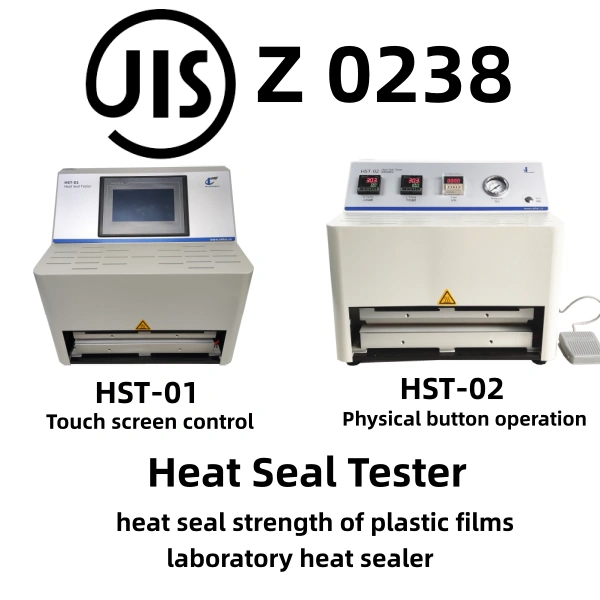
HST Series Heat Seal Tester
The HST Series is a compact laboratory instrument developed for precise seal preparation in accordance with JIS Z 0238 and other international testing practices.
It accurately controls three essential sealing variables:
| 매개변수 | 사양 |
|---|---|
| Temperature Range | 주변 온도 ~ 300°C |
| 온도 정확도 | ±0.2°C |
| 밀봉 시간 | 0.1–9999 초 |
| 밀봉 압력 | 0.15–0.7 MPa |
| 씰 턱 크기 | 330 × 10 mm |
| 에어 서플라이 | 0.7 MPa |
| Air Port | Φ6 mm PU 호스 |
| 전원 공급 장치 | AC 220 V, 50 Hz |
The instrument delivers highly repeatable sealing conditions, making it suitable for laboratory research, incoming material inspection, and production quality verification.
Two Models Available for Different Laboratory Requirements
To accommodate different laboratory workflows, the HST Series is available in two configurations while maintaining identical sealing performance.
HST-01 Touchscreen Heat Seal Tester
그리고 HST-01 features an intuitive color touchscreen interface for convenient parameter setting and operation.
Features include:
- Full touchscreen operation
- 디지털 파라미터 입력
- Precise temperature control
- Programmable sealing time
- Pneumatic pressure application
- Excellent repeatability for laboratory testing
This model is recommended for laboratories that perform frequent testing or require rapid parameter adjustments during material development.
HST-02 Manual Button Heat Seal Tester
그리고 HST-02 provides the same sealing accuracy using a traditional push-button control panel.
Features include:
- Manual button operation
- Stable temperature regulation
- Identical sealing performance
- Pneumatic sealing system
- Durable mechanical controls
- Cost-effective laboratory solution
The HST-02 is ideal for routine quality control laboratories that prefer straightforward operation while maintaining compliance with JIS Z 0238.
Typical Materials Evaluated
The HST Series supports evaluation of numerous heat-sealable materials, including:
- 폴리에틸렌(PE)
- 폴리프로필렌(PP)
- PET laminated films
- Nylon composite films
- 알루미늄 호일 적층재
- Coextruded barrier films
- 의료용 포장 필름
- Pharmaceutical blister materials
- 종이-플라스틱 적층재
- Composite flexible packaging
The instrument is especially useful for determining the 플라스틱 필름의 열접착 강도 used in food, pharmaceutical, and industrial packaging.
Typical Applications Across Industries
Many industries rely on JIS Z 0238 testing during product development and quality assurance.
대표적인 적용 분야는 다음과 같습니다:
- Flexible food packaging
- Medical pouch manufacturing
- 의약품 포장
- Retort pouch development
- 진공 포장
- Stand-up pouch production
- 냉동 식품 포장
- 음료 포장
- Agricultural chemical packaging
- Consumer goods packaging
For R&D teams, the laboratory heat sealer provides repeatable sealing samples for process optimization. For quality engineers, it verifies whether production materials continue to meet sealing performance requirements.
Related Test Standards
비록 JIS Z 0238 defines seal preparation procedures, complete seal evaluation often combines multiple standards.
| 표준 | 목적 |
|---|---|
| JIS Z 0238 | Laboratory heat seal preparation |
| ASTM F2029 | Heat sealability of flexible barrier materials |
| YBB 001220 | Pharmaceutical packaging heat sealing |
| ASTM F88 | Seal strength measurement |
| ASTM D882 | Tensile properties of plastic films |
Using these standards together provides a comprehensive understanding of sealing quality, process capability, and package performance.
왜 Cell Instruments를 선택해야 할까요?
Cell Instruments has extensive experience in laboratory testing solutions for packaging materials and mechanical property evaluation.
Our capabilities include:
- Standard laboratory testing instruments
- 맞춤형 고정구
- 다중 스테이션 테스트 시스템
- Integrated testing solutions
- Technical application support
- Global customer service
Beyond supplying a 열 밀봉 시험기, we assist customers in selecting suitable testing methods for packaging development, process validation, and quality assurance.
Whether you are evaluating new sealant materials, optimizing production parameters, or verifying compliance with JIS Z 0238, the HST Series provides consistent and repeatable laboratory sealing performance that supports confident engineering decisions.