
Flexible coated materials often experience repeated bending, folding, and mechanical deformation during manufacturing, transportation, installation, and daily use. These repeated stresses can create surface cracks, coating failures, or hidden damage that reduces product performance. ISO 7854 provides standardized methods for evaluating the resistance of coated fabrics to flex cracking, helping manufacturers understand how materials withstand repeated flexing conditions.
Profesjonalista flex durability tester designed for ISO 7854 testing allows laboratories to simulate repeated mechanical deformation and measure the durability of coated fabrics, films, and flexible composite materials. By generating controlled flexing movements and evaluating crack formation, manufacturers can improve material selection, optimize production processes, and ensure long-term product reliability.
For industries using coated textiles, synthetic leather, protective fabrics, and flexible polymer-based materials, ISO 7854 testing provides valuable data for quality control, product development, and performance verification.
What Is ISO 7854 Flex Testing?
ISO 7854 is an international standard that specifies methods for determining the resistance of coated fabrics to flexing. The standard evaluates how a coated material responds to repeated mechanical movements that may cause cracking, peeling, or coating deterioration.
Unlike simple tensile or tear tests that measure single-load mechanical strength, ISO 7854 focuses on fatigue behavior under repeated deformation. Many flexible materials may perform well under initial strength tests but fail after thousands of bending cycles. Flex testing identifies these weaknesses before products reach the market.
The test is especially important for materials where coating integrity affects functionality, such as:
- Waterproof protective fabrics
- Inflatable products
- Synthetic leather
- Outdoor textile coatings
- Industrial protective covers
- Medical and hygiene-related coated materials
- Automotive interior materials
A reliable ISO 7854 test method helps manufacturers predict service life and improve resistance against real-world mechanical stresses.
Why ISO 7854 Testing Is Important for Material Quality Control
Repeated flexing is unavoidable in many applications. A coated fabric may be folded during packaging, repeatedly bent during operation, or exposed to vibration and movement during transportation.
Without proper flex durability evaluation, several problems may occur:
- Surface coatings may develop cracks
- Barrier properties may decrease
- Waterproof performance may be reduced
- Appearance quality may deteriorate
- Product lifespan may become unpredictable
ISO 7854 testing helps engineers identify whether a material can maintain its functional properties after repeated deformation.
For manufacturers, test results support:
Material selection:
Comparing different coating formulations, fabric structures, and production processes.
Quality assurance:
Monitoring production consistency and detecting variations between batches.
Research and development:
Improving polymer coatings, laminates, and composite structures.
Customer compliance:
Providing standardized test data for product approval and certification requirements.
ISO 7854 Test Methods and Testing Principles
ISO 7854 includes different approaches for evaluating coated fabric flex resistance. The selected method depends on the material type, application requirements, and expected service conditions.
Common evaluation principles include repeatedly flexing a prepared specimen under controlled conditions and examining the material afterward for damage.
The main evaluation indicators include:
| Pozycja oceny | Description |
|---|---|
| Powstawanie pęknięć | Determines whether visible cracks appear after flexing |
| Coating damage | Evaluates peeling, separation, or surface deterioration |
| Flex resistance | Measures the ability of the material to withstand repeated deformation |
| Appearance changes | Checks surface quality after testing |
The testing process generally includes:
- Preparing standardized specimens according to ISO 7854 requirements.
- Installing samples into the flex testing equipment.
- Applying repeated bending or folding movements.
- Completing the required number of flex cycles.
- Inspecting the specimen for cracks or coating failure.
The result provides information about the material’s durability under repeated mechanical stress.
Understanding the ISO 7854 Crumple Method
The crumple method is one of the approaches associated with coated fabric flex durability evaluation. This method simulates repeated deformation caused by compressing, folding, and irregular bending.
During the crumple method test, the specimen experiences multidirectional mechanical stress rather than a simple straight bending movement. This makes it suitable for evaluating materials that may encounter complex deformation during actual use.
The crumple method is valuable because real products rarely experience perfectly controlled bending. Materials used in bags, protective covers, garments, and flexible containers may be squeezed, folded, and compressed repeatedly.
A controlled crumple test helps engineers understand:
- How quickly cracks appear
- Whether coating adhesion remains stable
- Whether flexible structures maintain performance
- How different formulations influence durability
When combined with visual inspection or permeability testing, the crumple method provides deeper insight into long-term material performance.
How a Flex Durability Tester Performs ISO 7854 Testing
A dedicated flex durability tester provides accurate and repeatable mechanical movement for ISO 7854 evaluation. Compared with manual folding tests, automated equipment reduces operator variation and improves testing consistency.
A typical ISO 7854 testing workflow includes:
Przygotowanie próbek
The coated fabric specimen is cut into the required dimensions and conditioned according to laboratory requirements.
Proper sample preparation ensures that test results represent the actual material properties rather than preparation errors.
Specimen Installation
The sample is securely mounted into the testing fixture.
The fixture design is important because uneven clamping can create abnormal stress concentrations and influence crack development.
Flexing Operation
The instrument applies repeated mechanical deformation based on the selected ISO 7854 method.
The testing system controls:
- Flexing frequency
- Movement distance
- Cycle number
- Testing duration
Damage Evaluation
After testing, engineers examine the specimen for:
- Pęknięcia
- Coating breaks
- Surface deterioration
- Structural failure
For advanced applications, laboratories may combine flex testing with additional analysis methods such as waterproof testing or barrier performance measurement.
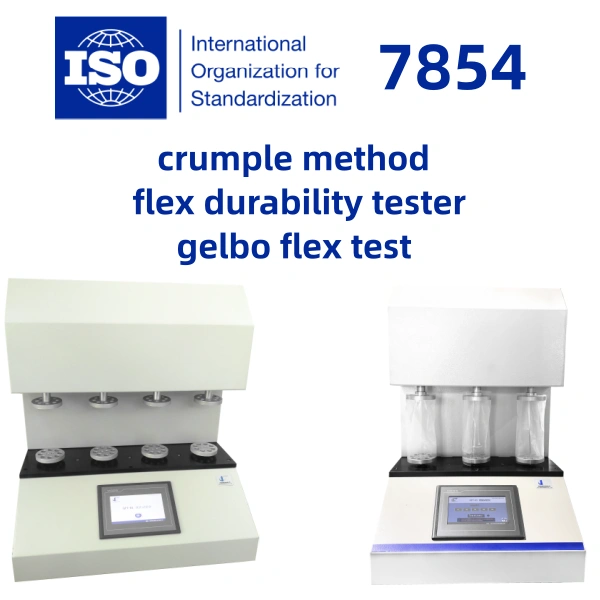
GFT Flex Durability Tester for ISO 7854 Applications
The GFT Flex Durability Tester from Cell Instruments is designed to provide controlled and repeatable flex resistance evaluation for flexible materials.
The instrument helps laboratories perform durability assessments by applying consistent mechanical movements and monitoring material changes after repeated stress exposure.
Key features include:
Automated Testing Control
The system uses PLC control and an HMI touchscreen interface, allowing operators to easily set test parameters and complete repeatable testing procedures.
Multiple Testing Stations
Available multi-station configurations improve laboratory efficiency by allowing several samples to be tested simultaneously.
This capability is especially useful for:
- Quality comparison studies
- Research and development projects
- Production quality monitoring
Programmable Test Conditions
The tester supports flexible test configurations to meet different material evaluation requirements.
Engineers can adjust testing parameters according to:
- Material structure
- Expected application conditions
- Internal quality standards
Stable Mechanical Performance
Precision mechanical control ensures consistent flexing movement, reducing testing variation and improving data reliability.
Applications of ISO 7854 Flex Durability Testing
ISO 7854 testing is widely applied in industries where coated material durability directly affects product performance.
Coated Textile Industry
Manufacturers use ISO 7854 testing to evaluate:
- PVC coated fabrics
- PU coated textiles
- Synthetic leather
- Outdoor fabrics
Testing helps ensure coatings remain intact during repeated use.
Medical and Protective Products
Flexible protective materials must maintain integrity during handling and repeated movement.
Zastosowania obejmują:
- Protective covers
- Medical protective fabrics
- Flexible barrier materials
Automotive Materials
Automotive interiors experience continuous bending and movement.
ISO 7854 evaluation supports development of:
- Seat materials
- Interior coverings
- Flexible decorative coatings
Industrial Applications
Industrial fabrics used in demanding environments require strong fatigue resistance.
Examples include:
- Equipment covers
- Flexible membranes
- Protective structures
Benefits of Using Automated Flex Durability Testing Equipment
A professional flex durability tester provides several advantages compared with manual evaluation methods.
Improved Repeatability
Automated movement control ensures each specimen experiences the same testing conditions.
Higher Testing Efficiency
Multiple samples can be evaluated under identical conditions, reducing laboratory workload.
Better Material Comparison
Engineers can compare different materials, coatings, and production processes using standardized procedures.
Reliable Quality Decisions
Accurate test data helps companies prevent premature product failure and improve customer satisfaction.
Dane techniczne urządzenia do badania trwałości GFT Flex
| Parametr | Model GFT-02 | Model GFT-01 |
|---|---|---|
| Kąt zgięcia | 440° (90 mm) lub 400° (80 mm) | 440° (90 mm) lub 400° (80 mm) |
| Pojemność | 3,5 N·m | 2,5 N·m |
| Ruch poziomy | 155 mm lub 80 mm | 155 mm lub 80 mm |
| Testing Stations | 3 | 4 |
| Wielkość próby | 280 mm × 200 mm | 280 mm × 200 mm |
| Zasilacz | 110–220 V | 110–220 V |
Related Standards for Flex Durability Evaluation
ISO 7854 is the primary standard for evaluating the flex cracking resistance of coated fabrics. Depending on application requirements, laboratories may also consider related mechanical and durability testing standards.
| Standard | Description |
|---|---|
| ISO 7854 | Determination of resistance of coated fabrics to flexing |
| ASTM F392 | Flex durability testing of flexible barrier materials |
| ISO 1421 | Tensile strength testing of coated fabrics |
| ISO 2411 | Coating adhesion testing of coated fabrics |
| ISO 2286 | Determination of fabric roll characteristics |
Choosing the Right ISO 7854 Testing Solution
Selecting suitable testing equipment depends on material type, expected application, and laboratory requirements.
Engineers should consider:
- Required test method
- Material thickness and flexibility
- Testing frequency
- Sample throughput
- Data recording requirements
- Future application expansion
Cell Instruments provides professional material testing solutions, including standard instruments, customized fixtures, and specialized testing systems for flexible materials and packaging applications.
With accurate mechanical simulation and reliable test control, an ISO 7854 flex durability tester helps manufacturers develop stronger materials, improve quality control, and deliver products with better long-term performance.