
Flexible packaging failures do not always begin with visible damage. During transportation, filling, stacking, and daily handling, barrier films can experience repeated twisting and compression that gradually weaken internal structures. A package may look intact while microscopic cracks have already formed inside the barrier layer, allowing oxygen, moisture, or contaminants to pass through. This is why ASTM F392 testing has become an important evaluation method for flexible barrier materials.
The ASTM F392 flex test method simulates mechanical stress that packaging materials encounter during real-world use. By using a specialized flex tester, laboratories can measure how films, laminates, and coated structures resist repeated flexing and determine whether mechanical fatigue affects barrier performance. The test is especially valuable for food packaging, medical packaging, pharmaceutical packaging, and other applications where maintaining package integrity is critical.
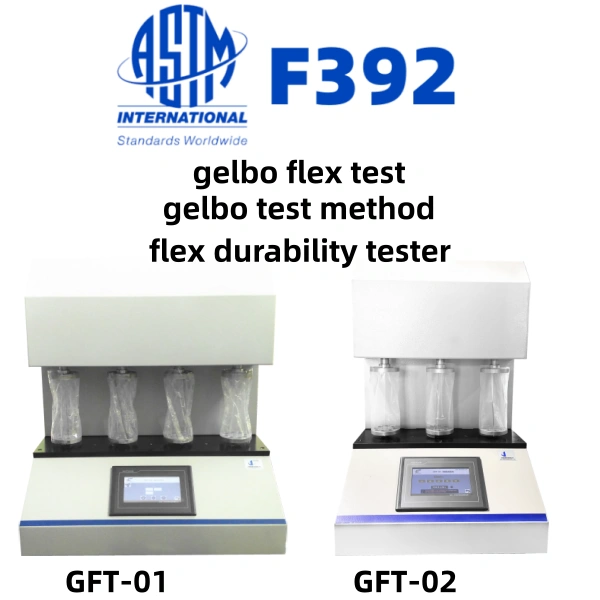
The GFT Flex Tester from Cell Instruments automates the ASTM F392 Gelbo flex procedure, providing controlled twisting and compression cycles to evaluate flex resistance, pinhole formation, and potential barrier degradation.
Why Flexible Barrier Materials Need Flex Durability Evaluation
Modern packaging designs increasingly use lightweight multilayer films because they provide strong protection with reduced material consumption. However, lightweight structures may become vulnerable when exposed to repeated mechanical deformation.
A typical flexible package experiences various stresses during its lifecycle:
- Folding during converting and packaging operations
- Compression during transportation
- Vibration during distribution
- Bending during storage and consumer handling
- Repeated movement of packaged products
These stresses can create microscopic defects in:
- Aluminum foil layers
- Metallized coatings
- EVOH barrier layers
- Adhesive interfaces
- Multilayer laminate structures
Traditional barrier testing methods measure material performance under static conditions. However, they may not reveal damage caused by repeated mechanical movement.
For this reason, manufacturers combine barrier testing with ASTM F392 flex durability evaluation to understand how packaging performs after simulated handling stress.
What Information Does ASTM F392 Testing Provide?
The purpose of ASTM F392 testing is to evaluate the resistance of flexible barrier materials against flex-induced damage.
A flex durability test can help engineers answer important questions:
- Will a laminate maintain barrier properties after transportation?
- Does a thin film structure develop pinholes after repeated bending?
- Which material combination provides better fatigue resistance?
- Does a new coating improve mechanical durability?
- How many flex cycles can a package withstand before performance decreases?
The test does not simply measure whether a material breaks. Instead, it evaluates how mechanical stress changes the functional performance of the packaging structure.
Typical evaluation results include:
| Evaluation Item | Purpose |
|---|---|
| Pinholes | Identify physical damage caused by flexing |
| Crack formation | Evaluate structural fatigue resistance |
| Oxygen transmission change | Determine barrier loss after flexing |
| Water vapor transmission change | Evaluate moisture protection performance |
These results help packaging engineers optimize material selection and package design.
Understanding the Gelbo Flex Test Method
The gelbo flex test method uses a controlled mechanical movement to reproduce repeated flexing conditions.
Unlike simple bending tests, Gelbo flex testing combines twisting and compression movements. This creates a more realistic simulation of the stresses experienced by flexible packaging during distribution and handling.
During testing, the specimen undergoes:
- Approximately 440° twisting over a 90 mm movement
- Horizontal compression movement
- Repeated cycling at controlled speed
The combined motion produces mechanical fatigue throughout the material structure.
The ASTM F392 procedure is commonly performed at:
- 45 cycles/minute
- Defined specimen dimensions
- Controlled flex cycles according to testing requirements
After testing, the material can be inspected directly or evaluated through additional barrier measurements.
How a Flex Tester Performs ASTM F392 Evaluation
A professional flex tester automates the repetitive mechanical actions required by ASTM F392 and improves test consistency compared with manual evaluation.
The typical testing workflow includes four major stages.
Sample Preparation and Installation
Flexible barrier samples are prepared according to the required dimensions.
Common sample specification:
| Parameter | Value |
|---|---|
| Sample size | 280 mm × 200 mm |
| Material type | Film, laminate, coated barrier structure |
The specimen is mounted securely on the test fixture to ensure consistent movement during flexing.
Controlled Flex Cycling
The instrument applies programmed twisting and compression movements.
The GFT Flex Durability Tester provides multiple testing modes:
| Mode | Flex Cycles | Application |
|---|---|---|
| A | 2700 cycles | Long-duration durability evaluation |
| B | 900 cycles | Standard performance comparison |
| C | 270 cycles | Material screening |
| D | 20 cycles | Full flex evaluation |
| E | 20 cycles | Partial flex evaluation |
Different cycle settings allow laboratories to compare materials efficiently during research, quality control, and production verification.
Damage Detection and Performance Analysis
After flex testing, engineers evaluate whether the material has experienced:
- Mechanical cracking
- Barrier layer damage
- Pinholes
- Increased transmission rates
For high-barrier packaging, many laboratories compare oxygen transmission rate (OTR) or water vapor transmission rate (WVTR) before and after flexing.
A significant increase indicates that mechanical stress has reduced protective performance.
Applications of ASTM F392 Flex Testing
Food Flexible Packaging
Food packaging depends heavily on barrier performance because oxygen and moisture can affect:
- Flavor retention
- Product freshness
- Shelf life
- Food safety
Common applications include:
- Snack packaging films
- Vacuum pouches
- Coffee bags
- Retort packaging
- Frozen food packaging
ASTM F392 helps manufacturers select laminate structures that maintain performance throughout distribution.
Medical and Pharmaceutical Packaging
Medical packaging requires reliable protection against environmental contamination.
Flex durability testing supports evaluation of:
- Sterile barrier pouches
- Medical device packaging
- Pharmaceutical protective films
- Cleanroom packaging materials
A packaging failure caused by mechanical fatigue can compromise sterility, making flex resistance an important quality parameter.
Industrial Barrier Films
Many industrial films must maintain protection despite repeated handling.
Applications include:
- Protective films
- Agricultural barrier films
- Chemical-resistant packaging
- Construction membranes
ASTM F392 testing provides valuable information about long-term durability.
GFT Flex Tester: Designed for ASTM F392 Applications
The GFT Flex Tester is developed for laboratories requiring accurate and repeatable flex durability evaluation.
The system provides several advantages for packaging material testing.
Automated PLC Control System
The industrial control platform provides:
- Stable operation
- Simple parameter setting
- Repeatable test conditions
- Reduced operator influence
The touchscreen interface allows engineers to quickly configure testing programs.
Multi-Station Testing Capability
The GFT series supports parallel testing:
| Model | Test Stations |
|---|---|
| GFT-01 | 4 stations |
| GFT-02 | 3 stations |
Multi-station operation improves laboratory efficiency by allowing comparison of multiple samples under identical conditions.
Programmable Testing Modes
Five preset modes allow users to perform:
- Quick screening
- Comparative material evaluation
- Extended durability testing
This flexibility makes the instrument suitable for both R&D laboratories and production quality control.
Technical Specifications of GFT Flex Durability Tester
| Parameter | GFT-02 Flex Tester | GFT-01 Flex Tester |
|---|---|---|
| Flex angle | 440° (90 mm) or 400° (80 mm) | 440° (90 mm) or 400° (80 mm) |
| Capacity | 3.5 N·m | 2.5 N·m |
| Horizontal stroke | 155 mm or 80 mm | 155 mm or 80 mm |
| Test stations | 3 | 4 |
| Sample size | 280 mm × 200 mm | 280 mm × 200 mm |
| Power supply | 110–220 V | 110–220 V |
ASTM F392 Compared with Other Packaging Performance Tests
Flex durability testing is often combined with other packaging evaluation methods.
| Test Method | Main Evaluation |
|---|---|
| ASTM F392 | Flex resistance and mechanical fatigue effects |
| ASTM D3985 | Oxygen transmission rate |
| ASTM F1249 | Water vapor transmission rate |
| ASTM F88 | Seal strength |
| ASTM D882 | Tensile properties |
Using multiple test methods provides a more complete understanding of packaging performance.
For example, ASTM F392 may reveal that a laminate loses barrier performance after flexing, while OTR testing quantifies the degree of barrier degradation.
Selecting the Right ASTM F392 Flex Tester
When choosing a flex testing system, laboratories should evaluate:
- ASTM F392 testing capability
- Number of test stations required
- Automation level
- Testing repeatability
- Sample compatibility
- Future testing requirements
For research laboratories, flexible programming allows evaluation of new material structures. For production environments, multi-station systems improve testing efficiency and quality monitoring.
A suitable ASTM F392 flex tester enables manufacturers to identify potential packaging failures before products reach the market.
ASTM F392 flex durability testing provides a practical way to evaluate whether flexible barrier materials can maintain protective performance after repeated mechanical stress. By simulating twisting and compression through a Gelbo flex test, manufacturers can identify hidden weaknesses such as pinholes, cracks, and barrier degradation before packaging failures occur in the market.
A reliable ASTM F392 flex tester helps packaging engineers compare material structures, optimize laminate designs, and improve product protection during transportation and handling. The GFT Flex Durability Tester from Cell Instruments delivers automated, repeatable testing for films, laminates, and coated barrier materials used in food, medical, pharmaceutical, and industrial packaging applications.
Combining ASTM F392 testing with oxygen transmission, water vapor transmission, tensile, and seal strength evaluations provides a complete understanding of packaging performance. This allows manufacturers to select more durable materials, enhance quality control processes, and develop packaging solutions with improved reliability and shelf-life protection.