
Plastic films play a critical role in modern packaging, from food pouches and pharmaceutical sachets to industrial liners and consumer product wrapping. One of the most important surface characteristics influencing package performance is the ASTM D1894 coefficient of friction (COF). An improper friction level can lead to production downtime, poor machinability, unstable pallet loads, or unsatisfactory consumer experience.
This article explains ASTM D1894 from a practical engineering perspective, including the purpose of the coefficient of friction test, testing principles, specimen preparation, result interpretation, and equipment selection. Whether you are a packaging manufacturer, quality control engineer, laboratory technician, or product developer, understanding ASTM D1894 helps ensure consistent product quality and efficient production.
Why ASTM D1894 Matters
ASTM D1894 is the standard test method used to determine the static coefficient of friction і kinetic coefficient of friction of plastic film and sheeting.
The test evaluates how much force is required to initiate movement between two contacting surfaces and how much force is needed to maintain continuous sliding. These measurements provide valuable information about the slip characteristics of packaging materials.
In packaging production, friction directly affects:
- High-speed form-fill-seal operations
- Automatic labeling equipment
- Cartoning and conveying systems
- Package stacking stability
- Roll winding performance
- Consumer handling experience
Because surface friction influences both manufacturing efficiency and final product performance, packaging COF testing has become a routine quality control procedure across numerous industries.
Understanding Static and Kinetic Coefficient of Friction
У "The coefficient of friction test measures two different friction behaviors.
| Параметр | Опис | Значення |
|---|---|---|
| Static COF | Force required to start movement | Indicates initial sticking or blocking tendency |
| Kinetic COF | Force required to maintain movement | Reflects continuous sliding performance |
A high static COF may cause films to stick together, while a very low COF may reduce stack stability. Similarly, kinetic COF influences how smoothly materials travel through packaging machinery.
The optimal friction level depends on the application rather than pursuing the lowest possible value.
Testing Principle of ASTM D1894
The principle of ASTM D1894 is straightforward.
A specimen is fixed onto a horizontal testing platform, while another specimen is attached to a weighted sled. The sled is pulled at a controlled speed using a testing instrument. During movement, the instrument continuously measures the pulling force.
The coefficient of friction is calculated as:
COF = Friction Force ÷ Normal Force
The highest force required to initiate movement represents the static coefficient of friction, while the average force during steady sliding represents the kinetic coefficient of friction.
Accurate speed control is essential because friction values are sensitive to movement speed. ASTM D1894 specifies a test speed of 150 mm/min, while ISO 8295 specifies 100 mm/min, making instrument compliance with the selected standard essential.
Вимоги до випробувальних зразків
Proper specimen preparation is critical for obtaining reliable data.
According to ASTM D1894:
| Specimen | Typical Size |
|---|---|
| Plane specimen | Approximately 250 × 130 mm |
| Film attached to sled | Approximately 120 × 120 mm |
| Thick sheet attached to sled | 63.5 × 63.5 mm |
The standard also recommends:
- Testing at least five specimens
- Using clean, uncontaminated samples
- Avoiding fingerprints on test surfaces
- Replacing specimens after each test
- Maintaining consistent machine direction during testing
Even small amounts of dust or oil can significantly influence measured friction values.
Factors Affecting the Coefficient of Friction of Plastic Film
У "The coefficient of friction of plastic film depends on many variables besides the material itself.
Common influencing factors include:
Slip Additives
Polyethylene and polypropylene films often contain slip additives that migrate to the surface over time, changing friction characteristics.
Surface Treatment
Corona treatment, plasma treatment, coatings, and printing alter surface energy and consequently affect friction behavior.
Film Aging
Many additives bloom gradually. Therefore, friction measurements may change days or weeks after production.
Temperature and Humidity
Environmental conditions influence polymer surface properties and should be controlled during testing.
Manufacturing Process
Extrusion conditions, chill roll temperature, and processing speed all affect surface morphology.
For meaningful comparisons, laboratories should maintain consistent conditioning procedures and environmental conditions.
Coefficient of Friction of Paper Compared with Plastic Film
Although ASTM D1894 primarily addresses plastic film and sheeting, similar friction testing concepts are also valuable for evaluating the coefficient of friction of paper.
Paper packaging applications include:
- Folding cartons
- Corrugated liners
- Паперові етикетки
- Coated paperboard
- Printing substrates
Paper surfaces often exhibit different friction characteristics due to roughness, coatings, fiber orientation, and moisture absorption. In many converting operations, friction between paper and plastic films also affects machine performance.
Understanding both the coefficient of friction of paper and plastic materials enables manufacturers to optimize multi-material packaging systems.
Applications of Packaging COF Testing
Packaging COF testing is widely used throughout product development and manufacturing.
Гнучка упаковка
- Snack bags
- Упаковка заморожених продуктів
- Retort pouches
- Vacuum bags
- Stand-up pouches
Фармацевтична упаковка
- Медичні сумки
- Blister lidding materials
- Sterile barrier systems
Споживчі товари
- Personal care packaging
- Household product wraps
- Cosmetic flexible packaging
Промислова упаковка
- Стретч-плівки
- Термоусадочні плівки
- Protective liners
- Heavy-duty bags
Routine friction testing helps identify production variation before products reach customers.
How to Select a COF Testing Machine
Choosing the right COF testing machine involves more than meeting the basic standard. Laboratories should evaluate several performance characteristics.
Серед важливих аспектів слід врахувати:
- Compliance with ASTM D1894 and ISO 8295
- Stable pulling speed control
- High-precision load cell
- Automatic calculation of static and kinetic COF
- Зручне управління
- Data storage and export capabilities
- Repeatable motion system
- Easy specimen installation
Modern laboratories also benefit from touchscreen interfaces, statistical analysis, and digital reporting functions.
COF-01 Coefficient of Friction Tester from Cell Instruments
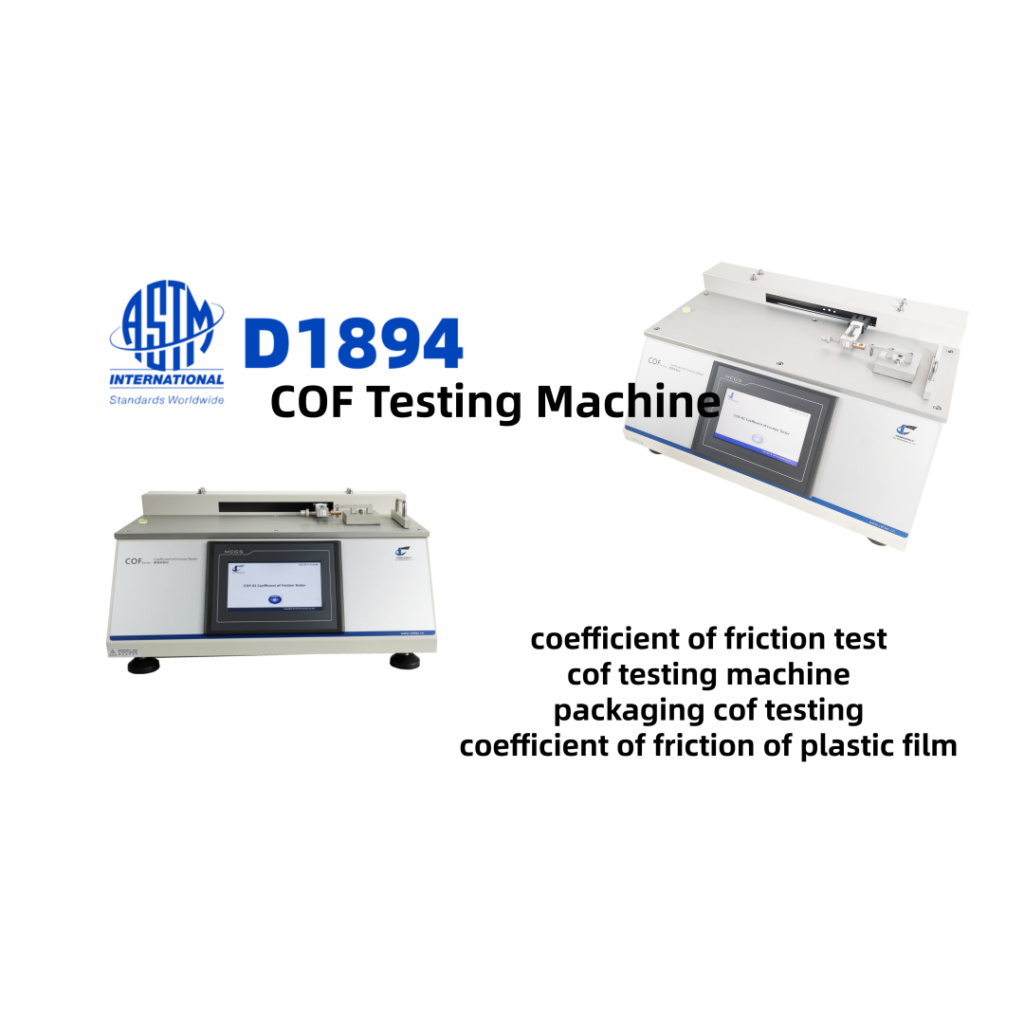
For laboratories requiring reliable coefficient of friction test results, the COF-01 Прилад для вимірювання коефіцієнта тертя from Cell Instruments provides a practical solution for routine quality control and research applications.
Key Specifications
| Пункт | Технічні характеристики |
|---|---|
| Load Cell | 5 N (customizable) |
| Точність | 0.5% F.S. |
| Sled Weight | 200 ±1 g |
| Test Speed | 150 mm/min (ASTM), 100 mm/min (ISO) |
| Motion System | Stepper motor with ball lead screw |
| User Interface | PLC control with touchscreen HMI |
| Виведення даних | Max, Min, Average COF, printer, optional RS-232 |
Practical Features
The COF-01 is designed to improve testing efficiency through:
- Dual-mode static and kinetic testing
- Automatic data acquisition
- Real-time friction curve display
- Repeatable precision motion
- Durable aluminum testing platform
- Customizable language interface
- Overload protection and automatic return
These features help laboratories produce consistent, repeatable results while simplifying daily operation.
Best Practices for Reliable ASTM D1894 Testing
To improve measurement consistency:
- Condition specimens under controlled laboratory conditions.
- Handle samples with gloves whenever possible.
- Use fresh specimens for every test.
- Keep the testing platform clean.
- Verify sled weight periodically.
- Calibrate the load cell regularly.
- Maintain the specified pulling speed.
- Test sufficient replicates for statistical confidence.
Consistent laboratory practices often contribute more to repeatability than the instrument itself.
ASTM D1894 and Related Standards
Although ASTM D1894 is one of the most widely used friction standards for plastic films, laboratories frequently work with related standards depending on the material and application.
| Стандартний | Заявка |
|---|---|
| ASTM D1894 | Static and kinetic COF of plastic film and sheeting |
| ISO 8295 | Coefficient of friction of plastic film and sheeting |
| ASTM D2534 | Coefficient of friction of wax coatings |
| TAPPI T549 | Friction testing for paper and paperboard |
Selecting the appropriate standard ensures results are relevant to product specifications and customer requirements.
Висновок
Surface friction significantly influences packaging performance, production efficiency, and product quality. ASTM D1894 provides a standardized method for measuring both static and kinetic friction characteristics, allowing manufacturers to monitor process consistency, evaluate material changes, and optimize package performance.
Whether assessing the coefficient of friction of plastic film, evaluating the coefficient of friction of paper, or conducting routine packaging COF testing, reliable equipment and standardized procedures are essential for obtaining meaningful results. A high-quality COF testing machine, combined with proper specimen preparation and controlled laboratory conditions, enables manufacturers to make informed quality decisions, reduce production variability, and improve packaging performance across a wide range of industries.