
What Is ISO 9895?
ISO 9895 specifies the short span compressive strength testing method used to determine the compressive strength of paper and paperboard under a very short unsupported span. The test is widely recognized for evaluating the intrinsic compression strength of fibrous materials while minimizing buckling effects that commonly influence longer-span compression tests.
For manufacturers of corrugated packaging, linerboard, testliner, kraft paper, and other paper-based packaging materials, ISO 9895 provides a fast, repeatable, and standardized approach to measuring compression performance. The data generated by this method plays a critical role in material development, quality control, supplier qualification, and process optimization.
A short span compression tester designed according to ISO 9895 enables laboratories to produce highly repeatable results that closely reflect the fiber network strength of paper and board. These measurements help engineers predict packaging performance before converting materials into finished cartons or corrugated boxes.
Why Is ISO 9895 Important?
Compression strength is one of the most important mechanical properties of packaging paper. Materials with insufficient compression resistance may collapse during converting, stacking, transportation, or storage.
The short span compression strength testing of paper and board provides several important advantages:
- Measures intrinsic compressive strength with minimal buckling influence
- Evaluates fiber bonding quality
- Supports raw material qualification
- Improves production consistency
- Helps optimize papermaking processes
- Predicts corrugated board performance
- Reduces packaging failures during transportation
Unlike conventional compression tests that use longer unsupported specimen lengths, the ISO 9895 method isolates the material’s true compressive behavior by using an unsupported span of only 0.70 mm.
Principle of the Short Span Compressive Strength Testing Method
The short span compressive strength testing method is based on applying a compressive force to a narrow paper specimen that is firmly clamped between two precision jaws.
The testing sequence includes:
- Prepare a specimen measuring approximately 15 mm wide.
- Clamp the specimen securely over a 30 mm clamping length.
- Maintain an unsupported gap of 0.70 mm between the clamps.
- Move the clamps toward one another at a controlled speed.
- Record the maximum compression force immediately before failure.
- Calculate the short span compressive strength based on the measured force.
Because the unsupported span is extremely short, the specimen fails primarily by fiber compression instead of structural buckling, producing more representative measurements of the material’s inherent strength.
How Does a Short Span Compression Tester Work?
A professional short span compression tester incorporates precision mechanical and electronic systems to ensure repeatable testing.
Typical system components include:
| Component | Function |
|---|---|
| Pneumatic clamps | Secure specimens with constant force |
| Precision loading system | Applies controlled compression |
| High-resolution load cell | Measures compression force accurately |
| PLC control system | Automates test operation |
| Touchscreen interface | Simplifies parameter setting |
| Motion control mechanism | Maintains constant test speed |
| Data processing software | Calculates compression strength |
| Printer or PC interface | Generates test reports |
These components ensure compliance with ISO 9895 while minimizing operator variability.
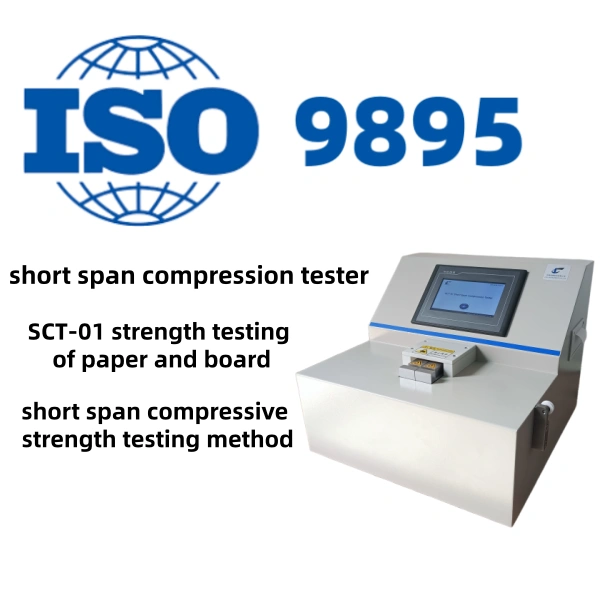
SCT-01 Short Span Compression Tester
The SCT-01 Short Span Compression Tester is specifically developed for performing short span compression strength testing of paper and board according to international standards.
Its design supports routine laboratory testing, production quality control, and research applications involving containerboard, kraft paper, linerboard, and paperboard materials.
Key Features
PLC-Controlled Operation
The PLC control system provides stable motion control and highly repeatable testing.
Pneumatic Sample Clamping
Uniform clamping force ensures secure specimen positioning and minimizes testing errors.
Adjustable Test Speed
Users can optimize testing conditions for different material grades.
Precision Force Measurement
A high-resolution load cell delivers accurate compression measurements throughout the testing cycle.
Multiple Force Units
Results can be displayed in:
- Newton (N)
- Kilogram-force (kgf)
- Pound-force (lbf)
Built-in Reporting
Integrated printing allows immediate documentation of test results.
Optional Computer Communication
RS-232 connectivity supports laboratory software integration and data management.
Technical Specifications
| Parameter | Specification |
|---|---|
| Test Range | 1–500 N (customizable) |
| Compression Distance | 0.3–2 mm |
| Clamping Length | 30 ±0.5 mm |
| Unsupported Span | 0.70 mm |
| Test Speed | 3 ±0.1 mm/min |
| Resolution | 0.01 N |
| Sample Size | 15 × 75 mm |
| Gas Pressure | 0.4–0.7 MPa |
| Gas Port | Φ6 mm |
| Power Supply | AC 110–220 V, 50/60 Hz |
Applications of ISO 9895 Testing
The ISO 9895 method is widely used across paper manufacturing and packaging industries.
Typical applications include:
- Corrugated container production
- Kraft paper manufacturing
- Linerboard production
- Testliner quality control
- Paperboard development
- Packaging material qualification
- Supplier evaluation
- Incoming material inspection
- Research laboratories
- University testing laboratories
The test is especially valuable during new product development because compression performance often correlates with finished package strength.
Materials Suitable for Testing
The standard is recommended for paper and paperboard materials with grammage typically between 100 g/m² and 400 g/m².
Common materials include:
- Kraft liner
- Testliner
- Fluting medium
- Containerboard
- Folding boxboard
- White top liner
- Recycled paperboard
- Virgin fiber paperboard
- Packaging paper
- Industrial paper grades
Machine Direction and Cross Direction Testing
Paper exhibits anisotropic mechanical properties due to fiber orientation during manufacturing.
For this reason, ISO 9895 recommends evaluating specimens in both:
- Machine Direction (MD)
- Cross Direction (CD)
Comparing MD and CD results helps engineers:
- Assess fiber orientation
- Improve papermaking consistency
- Optimize converting performance
- Predict box compression behavior
- Evaluate production stability
Benefits for Quality Control
Routine implementation of ISO 9895 testing offers significant quality assurance advantages.
Manufacturers can:
- Detect process variations earlier
- Reduce customer complaints
- Improve packaging reliability
- Verify raw material consistency
- Optimize fiber utilization
- Support lightweight packaging initiatives
- Lower production waste
- Strengthen supplier quality management
The rapid testing cycle also makes the method suitable for frequent in-process inspections.
ISO 9895 Compared with Other Compression Standards
| Standard | Test Focus | Typical Application |
|---|---|---|
| ISO 9895 | Short span compressive strength | Paper and paperboard intrinsic compression strength |
| TAPPI T826 | Short span compression | North American paper industry |
| DIN 54518 | Short span compression | German paper testing |
| BS 7325 | Compression testing | British paper quality evaluation |
| GB/T 2679.10 | Short span compression | Chinese paper testing |
| QB/T 2386 | Paper compression testing | Industrial quality control |
Although these standards follow similar testing principles, laboratories often select the standard required by customers, regulatory bodies, or regional markets.
Selecting the Right Short Span Compression Tester
When choosing a short span compression tester, engineers should evaluate several technical factors:
- Compliance with ISO 9895 and related standards
- High-precision load cell performance
- Stable pneumatic clamping system
- Accurate unsupported span control
- Repeatable motion control
- User-friendly touchscreen interface
- Data export capabilities
- Software compatibility
- Calibration convenience
- Long-term operational reliability
A well-designed instrument ensures accurate results while reducing operator influence and improving laboratory efficiency.
Why Choose the SCT-01 Short Span Compression Tester?
The SCT-01 combines precision mechanics, intelligent control, and compliance with international testing standards to support demanding laboratory environments.
Whether used in paper mills, packaging manufacturers, quality inspection laboratories, or research institutions, the system delivers reliable measurements that help improve product consistency, optimize manufacturing processes, and verify material performance according to ISO 9895 and other internationally recognized short span compression standards.