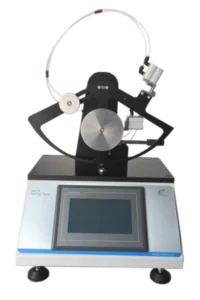
Plastic films used in packaging must withstand impacts during manufacturing, transportation, storage, and end-use handling. Insufficient impact resistance can lead to punctures, tears, product damage, and customer complaints. A falling dart impact tester provides a reliable and standardized method for evaluating the impact resistance of plastic films and sheets by measuring the energy required to cause failure under controlled conditions.
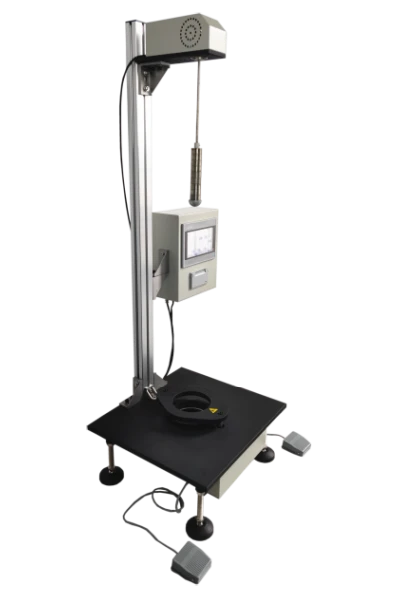
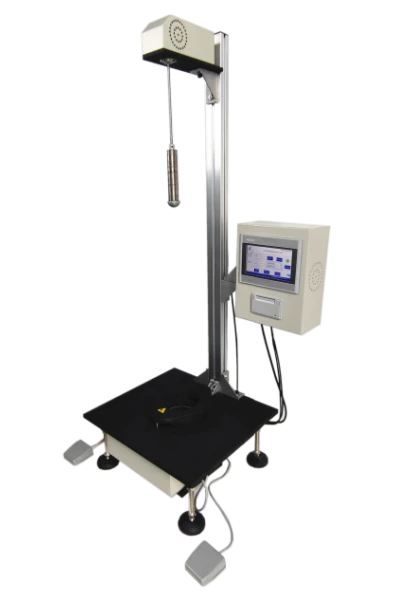
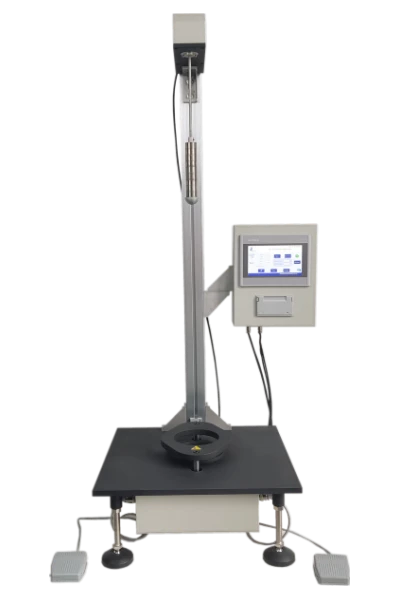
The FDT-01 Falling Dart Impact Tester from Cell Instruments is designed for accurate determination of impact resistance in accordance with ASTM D1709 and ISO 7765-1. Featuring PLC control, automated calculations, pneumatic specimen clamping, and precise electromagnetic dart release, the system enables laboratories and manufacturers to perform repeatable and efficient dart drop tests for quality control, product development, and material comparison.
What Is a Falling Dart Impact Tester?
A falling dart impact tester is an instrument used to determine the impact resistance of plastic films by dropping a hemispherical dart from a specified height onto a clamped test specimen.
The test measures the impact energy that causes failure in approximately 50% of tested specimens. This value serves as a critical indicator of film toughness and resistance to puncture during real-world handling and transportation conditions.
The test is widely used for:
- Flexible packaging films
- Agricultural films
- Stretch films
- Shrink films
- Medical packaging films
- Industrial protective films
- Barrier packaging materials
- Laminated film structures
By quantifying impact resistance, manufacturers can optimize film formulations, reduce material costs, improve product durability, and maintain consistent production quality.
How Does the Dart Impact Test Work?
The dart impact test for plastic film simulates a sudden impact event using a free-falling hemispherical dart.
The testing procedure generally includes:
- Preparing film specimens of appropriate dimensions.
- Clamping the specimen securely.
- Selecting the specified dart weight.
- Releasing the dart from the prescribed height.
- Observing whether the specimen passes or fails.
- Adjusting dart weight according to the selected testing method.
- Calculating the 50% failure impact level.
The result may be expressed as:
- Impact failure mass (g)
- Impact energy (J)
- Comparative impact resistance values
Because the test closely represents practical puncture and impact conditions, it is widely accepted throughout the packaging industry.
FDT-01 Falling Dart Impact Tester Features
Intelligent PLC Control System
The FDT-01 incorporates an industrial-grade PLC control platform combined with a 7-inch touchscreen interface.
Benefits include:
- Simplified operation
- Stable industrial performance
- Reduced operator error
- Fast test setup
- Easy parameter configuration
The intuitive user interface minimizes training requirements while maximizing laboratory efficiency.
Automatic Result Calculation
Traditional dart impact testing often requires manual calculations and data processing.
The FDT-01 automatically:
- Records pass/fail results
- Calculates impact resistance values
- Generates statistical results
- Displays impact energy values
- Reduces calculation errors
This significantly improves productivity and data reliability.
Electromagnetic Dart Release
The electromagnetic suspension mechanism provides:
- Consistent release conditions
- Repeatable drop performance
- Reduced mechanical interference
- Improved testing accuracy
Uniform dart release is critical for obtaining reproducible impact resistance results.
Pneumatic Sample Clamping
The pneumatic clamping system ensures:
- Secure specimen holding
- Consistent clamping pressure
- Reduced specimen distortion
- Improved repeatability
Reliable specimen positioning is essential for achieving accurate test results.
Enhanced Safety and Operator Convenience
The system includes:
- Foot-switch operation
- Dedicated test button
- Integrated observation lighting
- Protective test structure
These features help improve laboratory safety while increasing testing efficiency.
ASTM D1709 Falling Dart Impact Test
ASTM D1709 Method A
ASTM D1709 Method A uses:
| Parameter | Specification |
|---|---|
| Dart Head Diameter | 38 mm |
| Drop Height | 660 mm |
| Typical Range | 50 g to 6 kg |
Method A is commonly used for thinner and lower-impact-resistance films.
ASTM D1709 Method B
ASTM D1709 Method B uses:
| Parameter | Specification |
| Dart Head Diameter | 50 mm |
| Drop Height | 1500 mm |
| Typical Range | 300 g to 6 kg |
Method B is generally preferred for tougher films requiring higher impact energy.
Both methods determine the dart weight corresponding to a 50% probability of specimen failure.
ISO 7765-1 Impact Resistance Testing
ISO 7765-1 specifies the determination of impact resistance of plastic films using a free-falling dart method similar to ASTM D1709.
Many international packaging manufacturers and testing laboratories use ISO 7765-1 for:
- Material qualification
- Supplier approval
- International product specifications
- Regulatory compliance documentation
The FDT-01 supports testing requirements aligned with both ASTM and ISO methodologies, making it suitable for global quality systems.
Why Is Dart Impact Testing Important?
Modern packaging materials are becoming thinner while maintaining demanding performance requirements. As downgauging continues across industries, impact resistance becomes increasingly important.
Dart impact testing helps manufacturers:
- Evaluate film toughness
- Compare material formulations
- Verify production consistency
- Monitor process variations
- Reduce packaging failures
- Support product qualification
- Meet customer specifications
- Demonstrate compliance with industry standards
For many packaging applications, impact resistance is a key quality attribute directly related to package integrity and product protection.